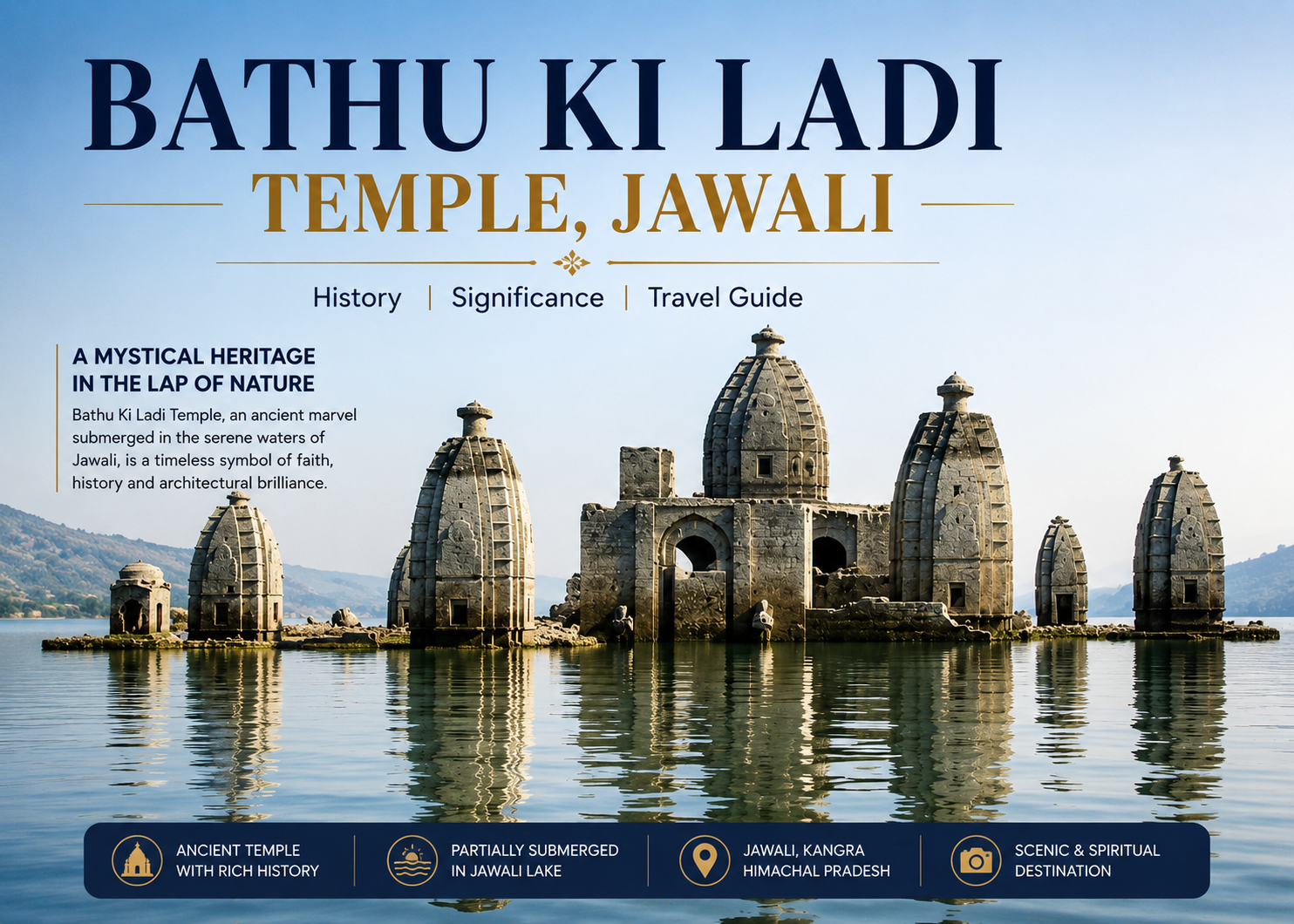
Bathu ki Ladi is a temple in Himachal Pradesh that spends eight months of the year completely underwater. Then, every summer, it rises straight out of the lake and stands there, as if nothing happened. It’s one of the strangest and most beautiful places tucked away in Kangra district, and most people haven’t even heard of it. That’s exactly why it’s worth your time.
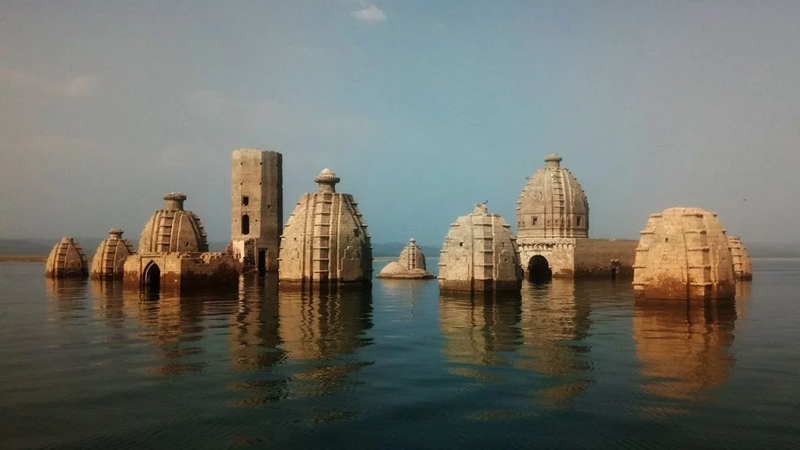
In this guide, we’re covering everything about Bathu Ki Ladi Temple, Jawali- its history, the best time to visit, how to reach it, and a few things nobody tells you before you go.
What Is Bathu Ki Ladi?
Bathu Ki Ladi is an ancient temple complex in Kangra district, Himachal Pradesh, famous for remaining submerged under the Pong Dam reservoir for nearly eight months every year. The temples become visible from March to June when the water level recedes, making it one of India’s most unique heritage sites.
Here’s the twist. For most of the year, you can’t see them at all. They sit fully submerged under the waters of Maharana Pratap Sagar, the reservoir created when the Pong Dam was built in the early 1970s. Only when summer arrives and the water level drops does the temple complex reappear, dripping and weathered but still standing strong.
Behind Bathu Ki Ladi: History and Legends
Ask five locals about the history of this place, and you’ll probably get five different answers. That’s part of its charm.
The most popular legend ties Bathu ki Ladi to the Pandavas from the Mahabharata. Story goes that during their exile, the five brothers passed through this region and decided to build a staircase connecting to the nearby Masrur rock cut temples, in a single night. Some versions say Lord Krishna even stretched the night longer to help them out. But time ran short, and the staircase was left half-built. You can still see the remains today, a set of forty incomplete stone steps.
Historians offer a more grounded version. Many believe the temples were actually built by the Hindu Shahi dynasty around the 8th century, making this cluster roughly 1,200 years old. Others credit Raja Sansar Chand of the Katoch dynasty, or a local Guleria ruler from the 6th century. Nobody has a definitive answer, and honestly, that unsolved mystery is part of what pulls people in.
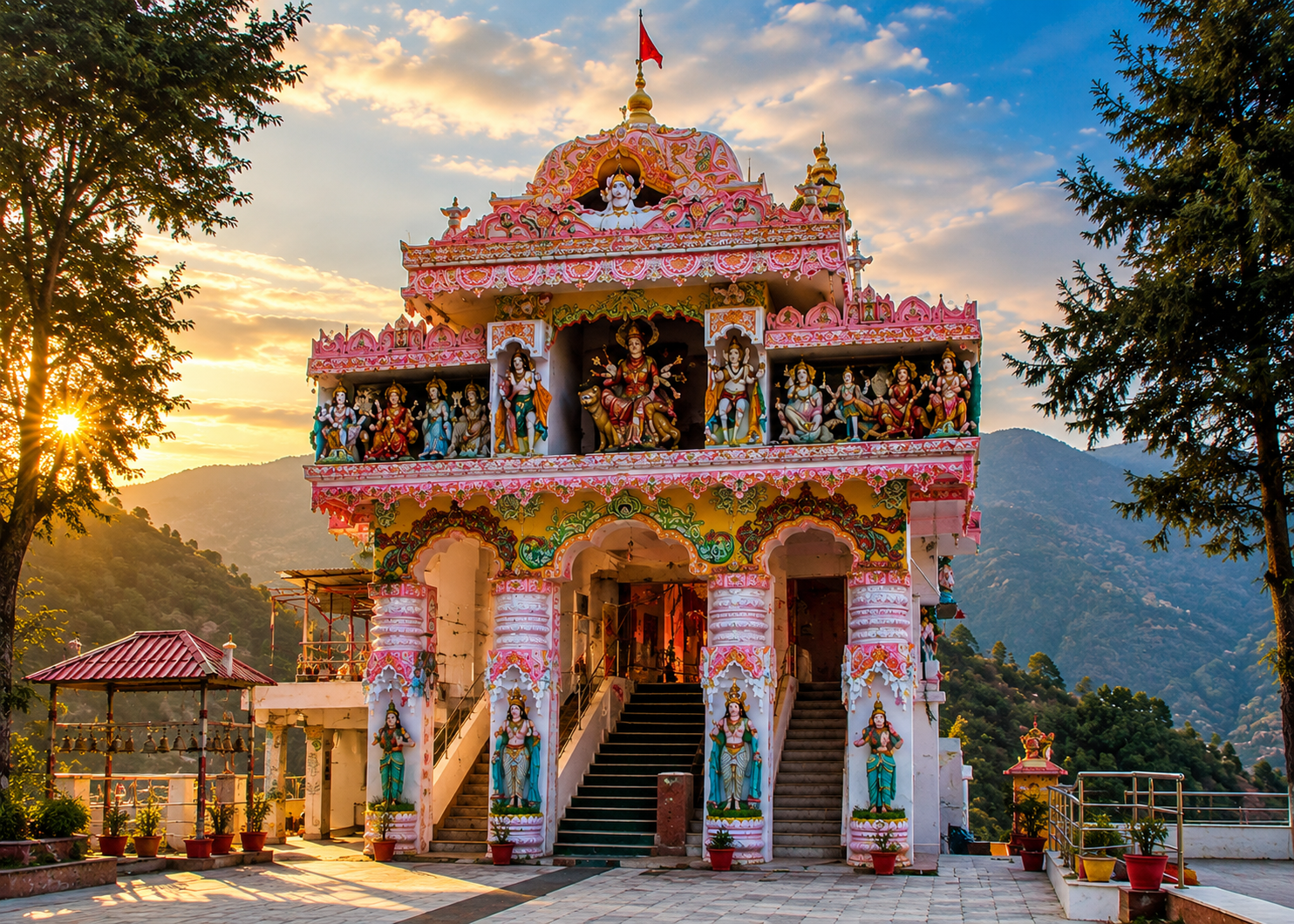
What everyone agrees on is this: the central shrine is dedicated to Lord Shiva, with Goddess Parvati also worshipped here. Surrounding it are smaller shrines, some featuring carvings of Lord Vishnu reclining on Sheshnag, along with Ganesha, Durga, and Hanuman. No priests are stationed here. Devotees worship on their own, lighting lamps and leaving flowers, the way pilgrims have probably done for centuries.
Architecture of Bathu Ki Ladi Temple
This is the part that surprises most visitors. The temples were built using a locally sourced material called Bathu stone, and it’s incredibly tough. Despite spending nearly eight months submerged every single year, decade after decade, the structures show minimal erosion. The carvings are still visible. The pillars are still standing.
The complex follows the Nagara style of temple architecture, known for its tall, curving towers that taper upward, common across northern India. The main shrine, larger than the rest, sits at the centre of the row, flanked by smaller temples on either side. Every monsoon, this structure disappears under murky reservoir water. Every summer, it reappears looking almost untouched. That kind of resilience is rare, even in stone.
Best Time to VisitBathu Ki LAdi: Timings and Water Levels
If there is one thing you absolutely need to plan around, it’s timing. Bathu ki Ladi isn’t a “visit any day of the year” kind of place.
The temple complex is visible and accessible roughly from March to June, with May and June offering the clearest, most complete view since water levels are at their lowest during peak summer. Once the monsoon arrives around July, the reservoir starts filling up again, and by the end of the season, the entire complex disappears underwater until the following March.
There’s no fixed “opening time” like a regular temple since this isn’t managed by a formal trust. Most visitors head there during daylight hours, generally between 9 AM and 5 PM, to make the most of natural light for boating and photography. Since roads and access points can be rough, it’s best to avoid arriving after dark.
A quick tip: water levels can vary year to year depending on rainfall and dam management. It’s always smart to check locally in Jawali or Dhameta before you set out, just to confirm the temple has actually surfaced that season.
Location and How to Reach Bathu Ki Ladi
Bathu Ki Ladi Temple Jawali sits close to Dhameta village, right on the edge of the Pong Dam reservoir in Kangra district, Himachal Pradesh. The nearest proper town is Jawali, which has decent connectivity to bigger cities like Dharamshala, Kangra, and Pathankot.
- By Road: Drive or take a taxi to Jawali or Dhameta first. From Jawali, a narrow approach road stretches around 6 to 10 kilometers toward the temple site, passing through small villages like Guglara. The road can get bumpy, so a sturdy vehicle helps.
- By Boat: During the accessible months, local boatmen operate from Dhameta and Nagrota Surian, ferrying visitors across the shallow reservoir waters straight to the temple. This is the more memorable way to arrive, gliding over calm water as the temple slowly comes into view.
- By Rail: The nearest railway station is Pathankot, roughly 80 to 100 kilometres away, with a narrow-gauge line connecting on to Jawali station.
- By Air:Gaggal Airport near Kangra, about 50 kilometres from Jawali, is your closest option.
Distance-wise, Bathu ki Ladi is around 60 to 67 kilometres from Dharamshala and Kangra, and about 80 kilometres from Pathankot.
Jawala Ji to Bathu Ki Ladi Distance
Since a lot of pilgrims combine their Jwala Ji darshan with a stop at this hidden gem, this comes up often. The Jawala Ji to Bathu Ki Ladi distance is approximately 50 to 55 kilometers by road, and the drive takes around 1.5 to 2 hours depending on traffic and road conditions.
The common route goes from Jawalamukhi towards Dehra Gopipur, then onward to Jawali, before you turn off onto the approach road leading to the temple site, a pleasant drive through small villages and open countryside. Plenty of travellers club Jwala Ji, Chintpurni, and Bathu ki Ladi into a single Kangra circuit, since they’re all reasonably close to one another.
Things to Do at Bathu Ki Ladi and Nearby Attractions
Beyond admiring the submerged shrines, there’s more to fill your day:
- Boating on the reservoir, especially around sunset, when the water turns golden and the temple silhouette looks dreamlike
- Birdwatching at the Pong Dam Wetland, a major stopover for migratory birds
- Photography of the half-submerged stones against open water
- Chatting with local boatmen, who share folklore you won’t find in any guidebook
Pair your trip with Masrur Rock Cut Temples (linked to the same Pandava legend), Kangra Fort, and Jwala Ji Temple, the famous Shakti Peeth known for its eternal flame. Some visitors say the scene here feels like a mini Goa, sandy banks, open water, hills in the backdrop, which isn’t something you’d expect in landlocked Himachal.
Travel Tips Before for VisitingBathu Ki Ladi
- Carry your own food and water. Near the temple site, options are limited to a couple of small stalls selling basic snacks, if you are lucky.
- Wear sturdy footwear. The roads and banks can be uneven, dusty, and occasionally muddy near the water’s edge.
- Double-check water levels before planning your trip. A late monsoon or early refill can shrink the visible window.
- Keep your visit respectful. This is still an active place of worship for many locals, even without resident priests.
- If you are on a two-wheeler, be cautious on the narrow stretch between Jawali and the temple. It’s scenic, but not always smooth.
FAQs
Q1. What is Bathu ki Ladi famous for?
It’s famous for being an ancient temple cluster that stays fully submerged under the Pong Dam reservoir for most of the year and only reappears in summer.
Q2. What is the best time to visit Bathu Ki Ladi Temple Jawali?
March to June is ideal, with May and June offering the clearest, most complete view of the temple complex.
Q3. How far is Bathu ki Ladi from Jawali town?
Roughly 6 to 10 kilometers by road, though the final stretch involves a narrow, sometimes rough approach.
Q4. What is the Jawala Ji to Bathu Ki Ladi distance?
Around 50 to 55 kilometers by road, taking approximately 1.5 to 2 hours via Dehra Gopipur and Jawali.
Q5. Is there an entry fee for Bathu ki Ladi?
No, there is no entry fee. It remains an open, informally maintained heritage and pilgrimage site.
Q6. Can Bathu ki Ladi be visited in winter?
During winter and monsoon months, the temple is completely underwater and inaccessible.
Conclusion
There is something quietly powerful about a place that spends most of its life hidden, only to resurface right on schedule, year after year, standing exactly where it always has. That’s the pull of Bathu ki Ladi. It’s not polished for tourists, there’s no ticket counter, no crowd management, just old stone, open water, and a story that historians still can not fully agree on.
If you are planning a Kangra trip and want something beyond the usual temple circuit, this one deserves a spot on your list. Time it right, between March and June, and you will witness something very few people ever get to see: a temple rising back into the world, one dry season at a time