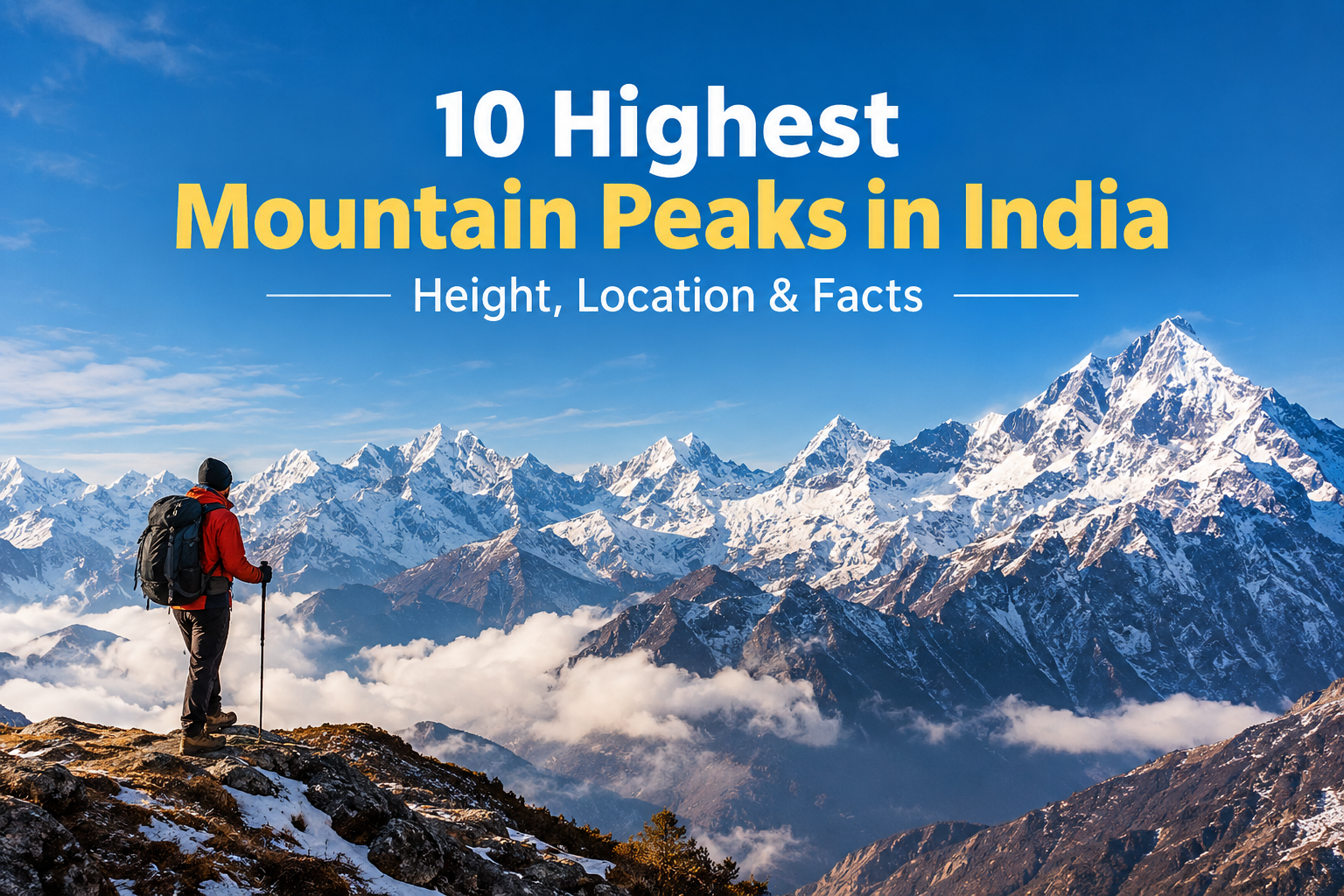
India is a shelter for several magnificent and breathtaking vistas on the entire planet, with its towering mountain ranges and breathtaking scenery. India is a country with unmatched natural beauty; starting from the snow-capped Himalayan peaks to the rough Western Ghats highlands. However, there are 10 mountain peaks in India that stand out as the most impressive and highest peaks in India among the numerous spectacular ones.
These peaks are not only evidence of the nation’s natural beauty, but they also fill the people of the nation with pride. Here, we will discuss in more detail the top 10 highest mountain peaks in India.
Quick comparison table
| Rank | Peak | Height (m) | Location | Mountain Range |
|---|---|---|---|---|
| 1 | Kangchenjunga | 8,586 m | Sikkim–Nepal Border | Himalayas |
| 2 | Nanda Devi | 7,816 m | Uttarakhand | Garhwal Himalayas |
| 3 | Kamet | 7,756 m | Uttarakhand | Garhwal Himalayas |
| 4 | Saltoro Kangri | 7,742 m | Ladakh | Karakoram |
| 5 | Saser Kangri I | 7,672 m | Ladakh | Karakoram |
| 6 | Mamostong Kangri | 7,516 m | Ladakh | Karakoram |
| 7 | Rimo I | 7,385 m | Ladakh | Karakoram |
| 8 | Hardeol | 7,151 m | Uttarakhand | Kumaon Himalayas |
| 9 | Chaukhamba I | 7,138 m | Uttarakhand | Garhwal Himalayas |
| 10 | Trisul I | 7,120 m | Uttarakhand | Kumaon Himalayas |
Top 10 Highest Peaks In India:
#1. Kangchenjunga Peak
Height: 8586 meters
Location: Sikkim
A few facts about Kangchenjunga Peak: Sikkim is home to the Kangchenjunga Summit. Kangchenjunga is the third-highest peak in the world and the highest peak in India. It sits at an astounding height of 8,586 metres (28,169 feet). Additionally, its name, Kanchenjunga, translates to “The Five Treasures of Snows,” representing gold, gems, silver, grain, and holy books.
It lies in the eastern Himalayas, along the international boundary between Sikkim and eastern Nepal. The mountain is especially important not only for its enormous height but also for its religious and cultural significance. The five main summits of the mountain are commonly identified as follows:
#1. Kangchenjunga Main– 8586m
#2. Yalung Kang– 8505m
#3. Kangchenjunga West– 8420m
#4. Kangchenjunga South– 8482m
#5. Kangchenjunga Central– 8494m
Together, they all make the enormous Kanchenjunga Massif.
Kangchenjunga peak was first climbed by the members of the 1995 British Kangchenjunga expedition– Joe Brown and George Band on 25 May 1995. As the peak lies on the border between India and Nepal, the Indian side of the peak is off-limits to climbers. Meanwhile, Joe Brown and George Band voluntarily halted their ascent before reaching the summit, honouring their promise to Tashi Namgyal, the Chogyal of Sikkim. The decision reflected the deep religious significance of the peak, which is regarded as sacred in Sikkimese tradition.
The mountain is also associated with Dzonga, regarded within Sikkimese traditions as a guardian deity. Because of these beliefs, the landscape around Kangchenjunga contains numerous sacred natural features, including mountains, lakes, caves, rivers and other sites.
#2. Nanda Devi Peak
Height: 7816 meters
Location: Uttarakhand
Few facts about Nanda Devi Peak: Situated in India, Nanda Devi is one of the world’s highest mountains and the country’s second-highest peak. Besides this, the peak holds the distinction of being the highest one that lies wholly within India, as Kanchenjunga straddles the border between India and Nepal. Nanda Devi was considered among the highest known mountains in the world until Dhaulagiri was surveyed by Western explorers in 1808.
The mountain is revered by the inhabitants. Also, it is thought that the goddess Nanda resides at its summit. As it is located inside a national park, Nanda Devi is a difficult mountain to climb. There are only a few expeditions permitted each year. Moreover, Nanda Devi lies in the Garhwal Himalayas of Uttarakhand, surrounded by the majestic mountain landscape of norther India.
The mountain and surrounding region are also associated with the famous Nanda Devi Jat Yatra, a pilgrim held in Uttrakhand. Nanda Devi is actually a part of a larger mountain massif, the mountain has two major summits:
#1. Nanda Devi Main– 7816m (principal summit and highest point of massif)
#2. Nanda Devi East: 7434m (separated from main summit)
The expidition led by Bill Tillman and Noel Odell made the first successful climb to Nanda Devi in 1936. At that time, the ascent was considered a major mountaineering achivement because Nanda Devi’s geography makes the access to the mountain particularly difficult. The mountain is protected by Nanda Devi Nationl Park, established in 1982. The park forms part of the larger Nanda Devi Biosphere Reserve.
However, Nanda Devi remains a well-liked, popular trip destination among hikers, mountaineers and trekkers from all over the world due to its breathtaking beauty and distinction as one of the highest peaks in India and in the whole world.
#3. Kamet Peak:
Height: 7756 meters
Location: Uttarakhand
Few facts about Kamet Peak: The Zaskar Mountain Range in the Chamoli District of Uttarakhand is home to Kamet peak, which is the highest summit in the area. Kamet is the second-highest peak in the Garhwal Himalayas and is surrounded by three prominent neighboring peaks. The mountain is located near Tibet and lies north of the main range, making it more secluded and less easily accessible than some other Himalayan peaks. Kamet Peak is another peak that is among the highest peaks in India.
The three neighbouring peaks that make Kamet Peak an astonishing mountain-
#1. Mukut Parbat– 7242m
#2. Abi Gamin– 7355m
#3. Mana peak– 7272m
The first attempt to climb this peak was done in 1855 by Frank Smith, Eric Shipton, RL Holdsworth, Raymond Greene and the expedition doctors- Bill Birnie and Lewa Sherpa, the members of British expedition. The name Kamet, as given and defined by Charles Meade, says that it is known to Tibetans as Kangmen, signifying “huge grandmother of a sacred snow chain”. However, Frank Smythe states in his book Kamet conquered that the origin of this name is Kangmed, a Tibetan word which means “higher snow”.
The Kamet region contains several important glaciers. Among them, the best-known are East Kamet Glacier and West Kamet Glacier. Similarly, these glaciers are important components of the Himalayan environment and contribute to the region’s river system.
#4. Saltoro Kangri Peak
Height: 7742 meters
Location: Jammu and Kashmir
Few facts about Saltoro Kangri Peak: While talking about the highest peaks in India, we can’t forget to mention Saltoro kangri Peak. The Saltoro Kangri mountain peak is located within the Saltoro Mountain range, which is a smaller sub-range of the larger Karakoram range. The highest range in the broader Himalayan mountains is the Karakoram range. The Siachen Glacier, the longest glacier in the world, and the Saltoro Mountains are both located towards the centre of the Karakoram mountain range.
Saltoro Kangri gives its name to the Saltoro rnage, a major subrange of the Karakoram. The range is closely associated geographically with the Siachen Glacier, one of the world’s largest glaciers outside the polar region. The glacier is surrounded by enormous mountains and feeds streams that ultimately form part of the Nubra River.
A British expedition led by J. Waller and S.N.T. Smith climbed the mountain in 1930 and it became the first successful ascent of Saltoro Kangri. At that time, climbing in the Karakoram range was considered difficult for many reasons and was logistically challenging.
This peak is not just geographically but has strategic importance attached to it because of Siachen Glacier. The region around Siachen is part of a disputed area involving India and Pakistan. Because of the military presence, the region become considerablly different than any ordinary Himalayan peaks.
Saltoro Kangri belongs to Karakoram, world’s one of the greatest mountain systems. The Karakoram contains several enormous peaks, including:
#1. K2– 8611m
#2. Gasherbrum– 8080 m
#3. Broad Peak– 8051m
#4. Gasherbrum II– 8035 m
#5. Saltoro Kangri– 7742m
#5. Saser Kangri Peak
Height: 7,672 meters
Location: Jammu and Kashmir
Few facts about Saser Kangri Peak: Saser Kangri comprises a cluster of five splendid mountain peaks. Among these mountain peaks, Saser Kangri Peak is the highest mountain peak, soaring up to 7,672 meters (25,171 feet) and holding the 35th spot on the global ranking of highest peaks. Saser Kangri Peak is also among one of the highest peaks in India.
The mountain is located in the Saser Muztagh, a subrange of the Karakoram, in the Ladakh region. It is surrounded by glaciers, steep reidges, and some of the most remote- high-altitude landscapes of the Indian Himalayas. Saser Kangri is especially notable for its difficult climbing history and its location close to the Nubra valley and major Karakoram range.
The Saser Kangri can be referred to as the principal summit with several significant peaks surrounding it, including:
#1. Saser Kangri I– 7672m
#2. Saser Kangri II East– approx. 7513m
#3. Saser Kangri II West– approx. 7495m
#4. Saser Kangri III– approx. 7495m
Together, these peaks form the Saser Kangri Massif. The first successful ascent took place in 1973, when an Indian expedition led by Dawa Norbu successfully reached the summit. The successful ascent was an important achievement in Indian mountaineering because Saser Kangri is surrounded by difficult terrain and is located in a remote part of the Karakoram.
#6. Mamostong Kangri Peak
Height: 7516 meters
Location: Jammu and Kashmir
Few facts about Mamostong Kangri Peak: Mamostong Kangri stands as the tallest peak within the Rimo Mustagh sub-range of the Great Karakoram range. Situated in a distant region near the Siachen Glacier, this mountain claims the 48th spot among the most elevated standalone summits worldwide. Also, don’t forget to include it among the highest peaks in India.
The mountain is notable for its remote location, spectacular glaciers and challenging mountaineering conditions. Because of its remoteness, Mamostong Kangri is very different from popular Himalayan peaks. Among the notable features of the region are the Rimo Glacier system and several other large glaciers.
The first successful ascent of Mamostong Kangri took place in 1984, led by an Indian-British expedition that successfully reached the summit. The Mamostong Kangri region lies within the high-altitude cold-desert environment of Ladakh.
#7. Rimo Peak
Height: 7385 meters
Location: Jammu and Kashmir
Few facts about Rimo Peak: Located in the Karakoram, the Rimo Range extends along the northern side of the Rimo Muztagh. This range comprises four peaks, with Rimo I being the highest among them. Towards the northeast are located the northeast Rimo Mountains and the Karakoram Pass. These hold significant importance as a trade route in Central Asia. Overall, Rimo Peak is among the highest peaks in India.
Rimo means “stripped mountain”. The massif lies in an extremely remote mountain near Siachen Glacier region and the Nubra valley. Because of the remoteness, the Rimo massif is considerably less accessible. The Rimo massif is made up of multiple important peaks rather than one distinct mountain. The principal peaks are:
#1. Rimo I– 7385m
#2. Rimo II– 7373m
#3. Rimo III– 7233m
#4. Rimo IV– 7169m
#5. Rimo V– 6882m
#6. Rimo VI– 6846m
In 1988, an Indian expedition successfully reached the summit of Rimo I for the first time. It was completed by Indian/Japanese team led by Hukam Singh and Yoshio Ogata.
#8. Hardeol Peak
Height: 7151 meters
Location: Uttarakhand
Few facts about Hardeol Peak: The mountain peak known as Hardeol or Temple of God, is a significant peak within the Kumaon Himalaya mountain range. It is also among the highest peaks in India. Located north of the Nanda Devi Sanctuary, Hardeol Peak is traditionally considered a protector of Nanda Devi. The peak lies in the Milam Valley within Uttarakhand’s Pithoragarh district
The name Hardeol has a deeper local connection than simply being a poetic description. A Himalayan journalist account of the 1978 expedition records that people of the Johar Valley traditionally called the mountain Hardoli or Hardol and regarded it as their presiding mountain deity.
AA fewhe Nanda Devi peak is just around its corner, it should be wrong to consider this mountain to be a part of Nanda Devi mountain system. Hardeol lies on the Northern ring of Nanda Devi. The mountain presents a challenging ascent, as demonstrated by a Polish expedition that ended in tragedy, resulting in two fatalities. Few decades later, the first successful ascent finally came on 31st May 1978, when the Indo-Tibetan Border Police (ITBP), led by S.P. Mulasi, reached the summit.
Historically, the route from the east passed through the Ikualari Glacier and Trishuli Valley before reaching the Hardeol Icefall. The surrounding region is part of the spectacular Johar/Milam Valley landscape. The region also has a long history of contact and trade with Tibet, giving the landscape cultural importance in addition to its geographical significance.
#9. Chaukamba Peak
Height: 7138 meters
Location: Uttarakhand
Few facts about Chaukamba Peak: Chaukamba Peak is one of the highest peaks in India. The highest peak among the Gangotri Group situated in the Garhwal Himalaya region of Uttarakhand, is the summit of Chaukhamba. The Gangotri Group includes a set of four peaks, and Chaukhamba I is the highest among them. The name ‘Chaukhamba’ originated from the presence of four major peaks positioned next to one another.
Its name comes from the Sanskrit-influenced words meaning “four pillars”, a reference to the four prominent summits that form the massif. The massif occupies a remarkable position between several important glacier systems. However, it lies between the Gangotri Glacier to the west, the Bagirathi Glacier to the north and the Satopanth Glacier to the east. These surrounding glaciers form a part of larger river systems of the Himalayas, making the mountain landscape important not only for mountaineering but also for the region’s water resources.
Just like any other peak we have discussed so far, this also has peaks surrounding it that together make the Massif, and these are:
#1. Chaukamba I– 7138m
#2. Chaukamba II– 7070m
#3. Chaukamba III– 6995m
#4. Chaukamba IV– 6854m
The arrangement of these peaks gives the mountain its characteristic four-column appearance and explains why the name is so appropriate. One of the most important geographical features associated with Chaukamba is the Gangotri Glacier. The broader Gangotri region is closely linked to the Bhagirathi, a major river that forms part of the Ganga river system. Additionally, the mountain’s eastern slopes are connected to the Satopanth Glacier.
On 13 June 1952, Édouard Frendo, Lucien George, and Victor Russenberger successfully made the first ascent of the summit. They climbed the mountains’s northern side, approaching from the Bhagirathi-Kharak Glacier.
Read Also: Unknown Facts about Himachal Pradesh
#10. Trisul Peak
Height: 7120 meters
Location: Uttarakhand
Few facts about Trisul Peak: Trisul, which is the highest peak in the cluster, gets its name from Lord Shiva’s Trishul weapon. The Trisul mountain range lies close to the Nanda Devi Sanctuary. Unlike a mountain with one prominent summit, Trisul is a massif consisting of three main peaks. If viewed from a distance, these peaks resemble the three-pronged Trishul associated with Lord Shiva.
It is located in the Garhwal Himalayas of Uttarakhand, close to the Nanda Devi region. Additionally, the massif forms an important geographical divide between the Rishi Ganga, Nandakini and Kali river valleys. The massif lies on the outer rim of the Nanda Devi sanctuary region.
The peak consists of three main massifs, which are as follows:
#1. Trisul I– 7120m
#2. Trisul II– 6690 m
#3. Trisul III– 6600 m
Trisul I is by far the highest and most prominent of the three. The expedition led by British doctor and explorer Dr Tom Longstaff completed the summit in 12 June, 1907. He was accompanied by Swiss guides Alexis and Henri Brocheral and Gurkha assistant Karbir Burathok. It is one of the most remarkable climb for its speed, the team climbed 1830 m in just one day.
Conclusion:
The Great Himalayan Mountain Ranges are the highest mountain range in the entire world. The aforementioned list of the “Top 10 Highest Peaks in India” details the peaks’ loctourists heights and other unique facts. Every year, hundreds of tourist flock to these mountains because of the snow. The remarkable significane is not just the geographical feature but also the strategic position. The Himalayan range in whole protects India from harsh winter and cold winds from the northern hemisphere.
The major rivers formed by these peaks and glaciers are the most important features and are the lifeline of the country. The massifs might be difficult to climb and almost impossible to reach, but they make our country live. They are regarded as sacred and held in high esteem within local traditions. From Hardeol to Trisul and Kangchenjunga, they hold some significant reverence in the heart of locals. And we should also respect their sentiment before going for an ascent.
FAQs:
#Q1. Which is the largest mountain peak in India?
A. Kangchenjunga is the largest mountain peak in India.
#Q2. Which mountain peak was the highest known mountain in the world until 1808?
A. Nanda Devi was the highest-known mountain in the world until 1808.
#Q3. Which Indian mountain peak is called the “Temple of God”?
A. Known as the “Temple of God,” Hardeol Peak holds cultural significance in the region.
#Q4. Does Trisul peak really resemble Lord Shiva’s Trishul?
A. Yes, it does. If looked at from a distance, it resembles the Trishul associated with Lord Shiva.
#Q5. Does Kangchenjunga lie solely in India?
A. No, half of its parts lie in Nepal and half inside India. It lies on the border between Nepal and India.
We hope you will find this article to be helpful and informative. You can give your valuable remarks regarding this article. Also, If you want more informative topics like this, stay in touch with our page.
Our next topic will be the Top 10 best places to visit in December in India. So, keep your eyes on our page.
Thank You.