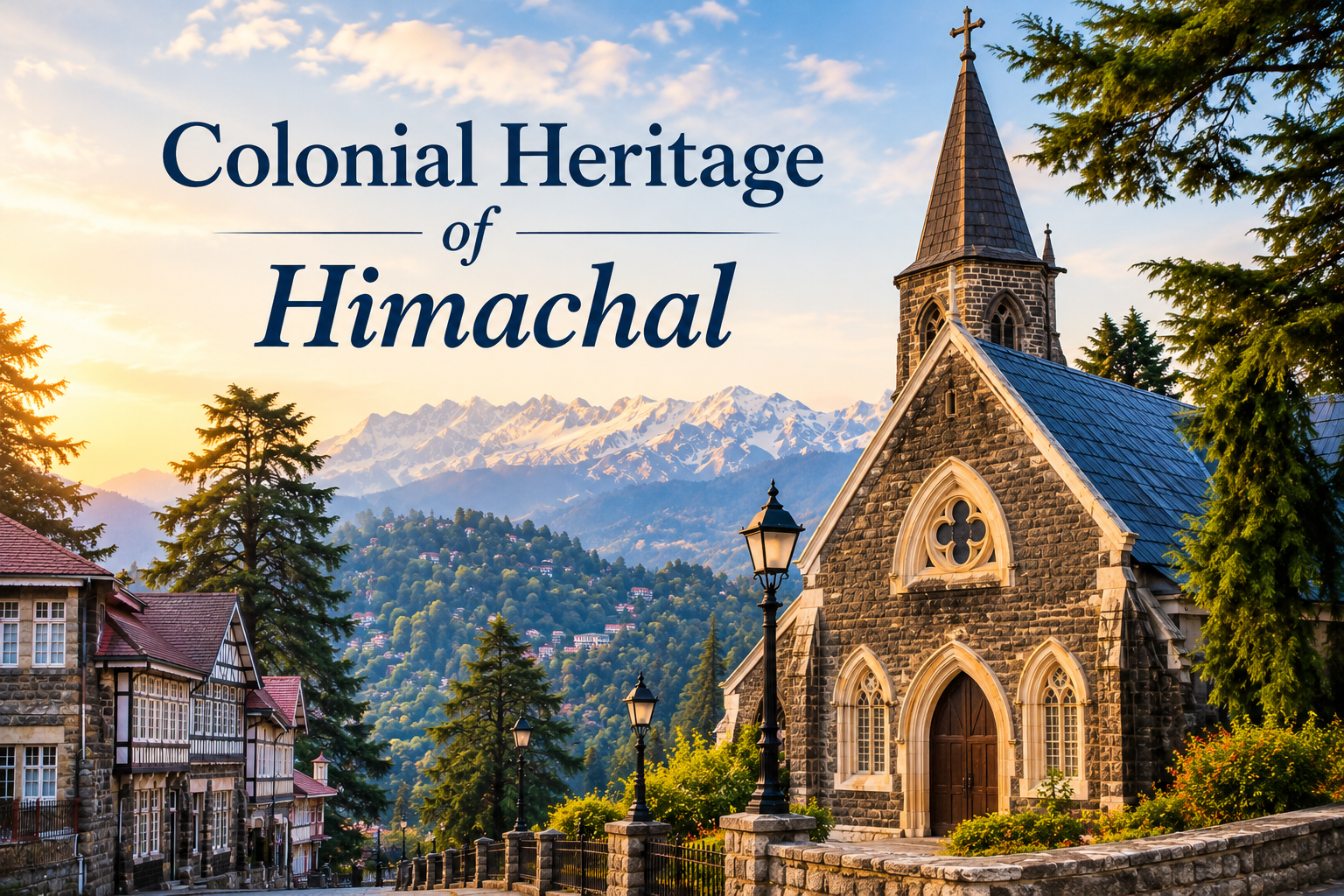
When the whole country was struggling for Independence, Himachal wasn’t behind. Baba Kanshi Ram, the renowned freedom fighter, is a well-known face in Himachal’s history of the freedom struggle. But before that, the British did rule us for over 200 years, and that goes for Himachal Pradesh too.
When the Anglo-Gurkha war took place in 1815-1816, Himachal was under many chaotic circumstances. The larger dynasties were falling, and rules were shifting. And that made it an easy opportunity for the British to assimilate the hill states into their territories. Many places in Himachal still had the names of colonisers due to their long-standing history.
Because of their history, they have left a belt of their heritage in the state. From grand churches to heritage buildings, many parts of Himachal Pradesh still tell the story of its colonial past. Whether it’s Shimla, Kangra, or other districts of Himachal Pradesh.
History of Colonial architecture in Himachal Pradesh
Himachal Pradesh’s colonial heritage is deeply connected to its historic architecture, landmarks, and cultural influences. Shimla served the British as their first summer capital of the hills, where they escaped the heat of the plains of Calcutta and Delhi. The Shimla became their first choice because of the pleasant weather and scenic mountains that lead to construction of many colonial architectures spread all over the town.
Apart from Shimla- Dharamshala, Dalhousie, Kasauli and parts of Chamba also attracted the interest of many colonisers to explore and leave their footprints behind. The name Dalhousie traces back to Lord Dalhousie, the British Governor-General whose administration is remembered for policies such as the Doctrine of Lapse.
The resulting architecture was distinctive because European architectural ideas had to be adapted to the steep Himalayan terrain, heavy rainfall, snowfall, and locally available materials such as stone and timber.
To understand colonial architecture, it is important to remember that the British did not introduce architecture to Himachal. Long before the colonial period, the Himalayan region had developed a sophisticated architectural style.
Major Colonial architectural style in Himachal Pradesh
Due to the influence of missionaries and officers residing in the town, they left behind a distinctive architectural style that separates these buildings from the ancient and Medieval ones. Colonial architecture in Himachal Pradesh is not a single style. British architects and builders used several European styles and adapted them to the Himalayan climate, terrain and local building traditions. The major styles are:
#1. Neo-Gothic style
One of the most recognisable colonial styles in Himachal Pradesh. It is also called “Gothic Revival”. The style was originally inspired by medieval European Gothic architecture, but the British architects and artists revived and adapted it during the 18th and 19th centuries.
Main features:
- Tall, narrow windows
- Pointed arches
- Stained glass
- Vertical proportions
- Steep roofs
- Decorative stonework
#2. Tudor Revival Style
This style was inspired by the architecture of England during the Tudor period. It became popular during the Victorian period, particularly in Britain and its colonies. In Himachal Pradesh, it was adapted rather than reproduced exactly. So the result was a combination of English Tudor influence, Himalayan climate and local materials.
Main features:
- Steeply pitched roofs
- Gables
- Large chimneys
- Timber framing
- Bay windows
- Stone and timber.
#3. Victorian architecture
Victorian architecture is not a single architectural style. It is better understood as a broad period that included styles such as a broad period that included styles as Neo-Gothic, Renaissance Revival, and Tudor Revival. Victorian architecture is characterised by eclecticism- architecture that freely combined features from different historical styles.
Main features:
- Large chimneys
- Bay windows
- Dorner windows
- Stone construction
- Timber
#4. Cottage style architecture
Cottage style architecture in Himachal Pradesh represents a meeting of traditional Himalayan building practices and European Hill station architecture. Shimla, Dalhousie and Kasauli became associated with this picturesque residential architecture.
Main features:
- Slopping roof
- Large windows and Verandas
- Thick stone foundation
- Wooden floor
- Stone fireplaces.
#5. Indo-European architectural style
This fusion of Indian architecture with European architecture became visible during the 19th and early 20th centuries. Unlike other European architecture, this style was made to reveal the local identity with the fusion of European style.
Main features:
- Adaptive cultural fusion
- Local Kath-Kuni style
- Slope roof
- Wooden window frames
- Sandstone ground floors
Colonial architecture in Shimla
The architectural styles that are prevalent in Shimla are Neo-Gothic style, Tudor Revival and local integration. You will find many colonial buildings in these styles. Shimla served the British as their summer capital. The town acquired an extraordinary collection of Churches, government buildings, bungalows, schools, hotels, etc.
There are few prominent British-era buildings in Shimla that we can still see standing tall today.
#1. Viceregal Lodge
Viceregal Lodge is perhaps the most significant colonial building in Shimla. It was completed in 1888 on Observatory Hill and served as the summer residence of the Viceroy of India. The building is primarily associated with English Renaissance Revival architecture. The building was also an important centre of British political administration.
After independence, it became the Indian Institute of Advanced Study.
#2. Christ Church
Known as the oldest church in North India, it stands out as the most prominent building of Shimla and can be seen from a distance. The foundation was laid on 9 September 1844 by Bishop Daniel Wilson, Bishop of Calcutta. It is designed in Neo-Gothic style, and the stained-glass windows in the Church that is shown describing 5 virtues of Christianity.
The Christ Church hosts popular prayers on Sundays, and the prayers are done in both English and Hindi.
#3. Gaiety Theatre.
The Gaiety Theatre demonstrates the social and cultural side of colonial Shimla. The theatre formed part of the entertainment environment surrounding the Mall. Its architecture incorporates Gothic Revival architecture characteristics, including pointed arches and vertical proportions. This infrastructure tells us the colonial architecture was not restricted to government buildings, but also created spaces for theatres, entertainment and social interactions.
#4. Gorton Castle
Gorton Castle is another important colonial landmark. Its architecture combines European influence with local stone and timber craftsmanship. The building illustrates the Victorian-era preference for elaborate historical styles while also demonstrating adaption to the Himalayan mountains.
#5. The Mall and the Ridge
Architecture in Shimla cannot be separated from its urban spaces. The Mall became the principal commercial and social street for colonial town, while the Ridge developed as a major public gathering space. Important buildings were positioned around the spaces, creating a distinctive colonial streetscape.
Colonial architecture in Kasauli
Kasauli is a small cantonment town that was established by the British in 1842. Because of this characteristic, it became an interesting example of colonial architecture in Himachal Pradesh. Unlike Shimla, where the architecture is more grand residences and institutions, Kasauli retained a more intimate character. Its colonial landscape consists largely of churches, military buildings, clubs and cemeteries.
The architecture was influenced by European styles but was modified to suit the Himalayan environment. Today, Kasauli’s colonial buildings form an important part of the town’s historical identity. There are some major colonial heritage buildings, and they are:
#1. Christ Church
The foundation of this church was laid in 1844, and the Church was opened for worship in 1853. The church came into existence as the Anglican community expanded around the British settlement. The church reflects the Gothic Revival style through its pointed arches, stained-glass windows, and a striking statue depicting Jesus with Joseph and Mary.
#2. Baptist Church
A fusion of Indian architectural style with Neo-Gothic, this Church was established in 1923. It is located quite conveniently beside the mall road of Kasauli. The building is particularly interesting because it demonstrates how Gothic architectural ideas continued to influence construction in Kasauli well into the 20th century.
#3. Kasauli club
This club trace back its origin back to 1880, when it was created as “Kasauli Reading and Assembly Room”. It was known to be as “Kasauli Club” in 1898. It functioned as a social gathering place associated with the British Cantonment and the colonial community of Kasauli. The Kasauli Club is significant because it belongs to the colonial hill-station architecture tradition of Kasauli.
Colonial architecture in Dalhousie
Dalhousie got its name after Lord Dalhousie, the then governor-general of India. The town of Dalhousie is famous for well-preserved Victorian and Scottish-style colonial architecture. Dalhousie is home to numerous colonial-era buildings, with some of the most notable examples including:
#1. St. John’s Church
Established in 1863, this historic church is often associated with local tales of hauntings in Dalhousie. The church showcases classic Gothic Revival architecture, complete with stained-glass windows, and remains the oldest functioning church in the area. It got its reputation as being the haunted Church with no official records and the myth of an old priest roaming the halls at midnight.
#2. St. Francis Catholic Church
Dating back to 1894, the church was constructed with the combined efforts of army officers and the local community. With over 130 years of history, the building stands out for its Victorian-era architecture and striking stained-glass windows. Surrounded by tall deodar and pine forests, it offers a serene setting for quiet mornings and peaceful evenings.
#3. St. Patrick’s Church
It is the largest Church in Dalhousie that built has reputation to hosts 300 people for Sunday mornings. Built in 1909, this church exhibits Gothic architecture well. It stands as a fine example of the architectural legacy left behind by the British. Surrounded by tall pine and deodar forests, the church is located just 1 km from the main bus stand. As with several other churches in Dalhousie, its maintenance and administration are overseen by the Catholic Diocese of Jalandhar.
#4. Brij Villa
It is a restored property that dates back to 1930 as a luxurious boutique hotel. This is a hotel you would want to stay at during your visit. The building beautifully combines European architectural influences with traditional Indian design elements. It is a restored hotel with a fine blend of nature and modernity, with historical significance. This place is just perfect for your stay and to learn about the colonial history of the place.
Colonial architecture in Dharamshala
Dharamshala, the famous hill station of Himachal Pradesh that shows the harmony between two religions living peacefully side by side. Dharamshala is a perfect escape both in summers and winters, and not just for nature walks, but its colonial history says something too. While taking a walk in the local streets, you would notice there are well-preserved colonial buildings perched beautifully in every corner. From Churches to bungalows, but many are private properties, so you cannot go in without the exclusive permission from the owners.
You can visit some historical sites, though, like:
#1. St. John in the Wilderness Church
Dedicated to St. John the Baptist, the church was built in 1852 along the road to McLeod Ganj. Built in the Neo-Gothic style, the church features a beautiful Belgian stained-glass window donated to Lady Elgin, the wife of Lord Elgin. This church has survived the 1905 earthquake, which destroyed much infrastructure around Kangra, Dharamshala, McLeod Ganj and killed over 19,000 people. Lord Elgin, the title of James Bruce, was the Viceroy of India who died in Dharamshala and was laid to rest in peace in this Churchyard. Making it significantly historical and famous.
#2. Government offices and Bungalows
Several government buildings in Dharamshala still stand as reminders of the town’s colonial-era past. While some colonial-era properties have lost their former charm over the years, others remain remarkably well preserved. Especially the private properties and small offices, the cobblestone paths and heritage sites. These architectural traditions have continued to inspire modern structures, blending historic influences with contemporary design.
Conclusion
Himachal Pradesh is not a state of one or two visiting sites. A visit here is anything but monotonous, with scenic landscapes, bustling streets, and colonial charm coming together to create the unique character of the “Queen of Hills.” This Queen has everything, from crown to cape, from culture to heritage. Alongside with the temples and forts, you can also visit the colonial heritage to know about the modern history of the place. As you stroll along Mall Road with a cup of chai, you may even uncover the story of how Shimla came under British control following the Anglo-Gurkha War and the defeat of the Gurkhas. Fascinating history, with the rich cultural stories passed on from generation to generation and sung by many folk artists.
FAQs
Q1. What makes Himachal a destination for colonial heritage?
Himachal Pradesh has a rich colonial heritage, with traces of its history visible across different parts of the state. From churches built in European style to colonial official government buildings.
Q2. Is there any colonial infrastructure in Dharamshala?
Yes, although there are many colonial infrastructures in Dharamshala, they have taken a significant hit after the devastating earthquake in 1905. You can still see the infamous Saint John in the wilderness church.
Q3. Which was the summer capital for the British in Himachal?
Shimla was the summer capital for the British, and you can see many colonial infrastructures there still standing and operating today.
Q4. Did the British take influence from local architecture to build their own buildings there?
Yes, cottage-style architecture is believed to have drawn inspiration from traditional local designs, blending them with European influences to create a distinctive architectural style.
Q5. Can I see these colonial infrastructures in other places in Himachal too?
Yes, you can, but the most prominent places are Shimla, Dalhousie, Dharamshala, and Kasauli. Kangra and Chamba are also home to several buildings that showcase distinctive European-style architecture.