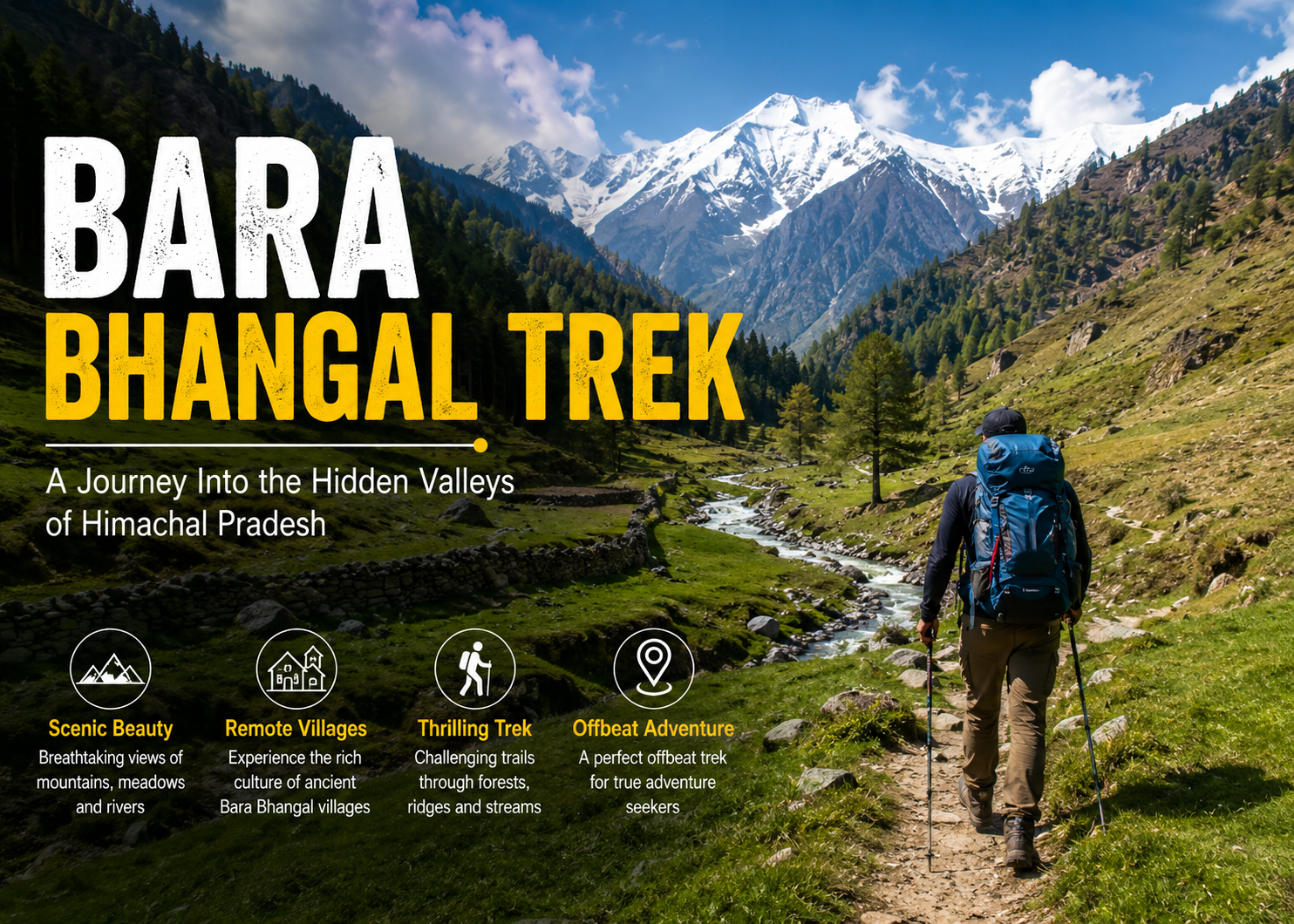
Some Himalayan treks reward you with mountain views. Others leave you with stories you will tell for years. The Bara Bhangal Trek somehow manages to do both. Forests become meadows. Meadows give way to high passes. And before it’s over, you’ve crossed one of Himachal’s most remote mountain routes
The Bara Bhangal Trek isn’t for everyone. But if you have read this far, you are probably wondering whether you are ready for it.
Let’s find out together. This guide will give you an overview of the route, cost, difficulty, and everything else you will need before you book.
What Is the Bara Bhangal Trek?
At its core, the Bara Bhangal Trek is a crossing. It starts in the Kullu valley near Manali, climbs over the Dhauladhar range, and drops into the Kangra valley on the far side. Two very different worlds, joined by nine or ten days of walking.
Locals call it the Shepherd’s Trail. That name isn’t decorative. Gaddi shepherds have moved their flocks along this exact path for generations, chasing the grass as the seasons turn.
The trek ends in the village of Bara Bhangal, sitting quietly beside the Ravi river. From there, one final climb carries trekkers down towards Bir, where paragliders drift over the valley on any clear afternoon.
Why Is It Famous?
Difficulty is only part of the story.
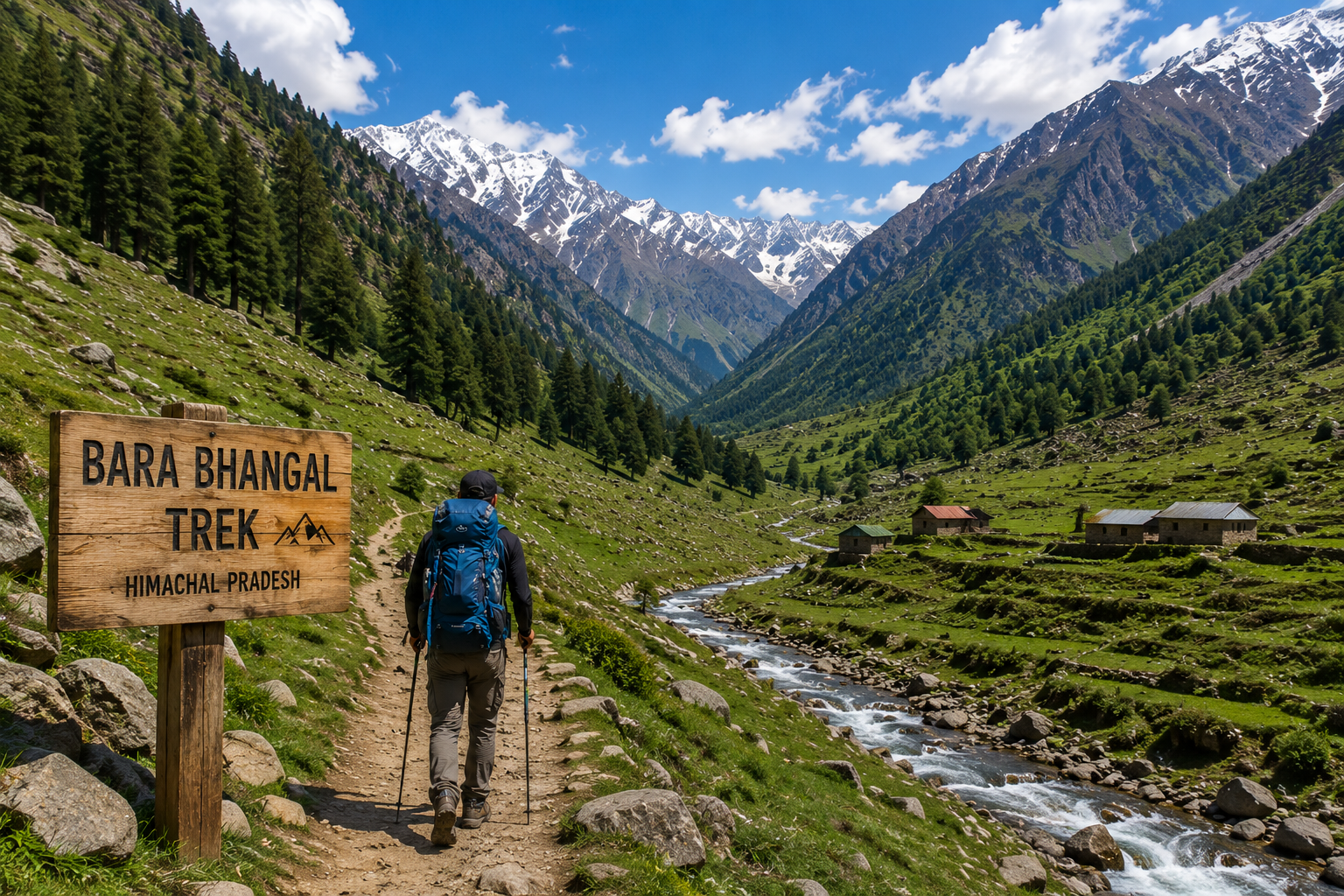
Early on, the trail winds through deodar forest, damp underfoot, the air thick with the smell of wet bark. Days later, it opens onto a pass near 4,800 metres, with Indrasan and Deo Tibba catching the first light. Few treks in Himachal offer that kind of contrast in one trip.
Then there’s the isolation. Cross Kalihani Pass, and the road disappears for days. No phone signal, no shops. Just mountains, shepherd huts, and whatever weather the Dhauladhar decides to send.
Bara Bhangal Trek Himachal Pradesh: Quick Overview
The trek runs across two districts, Kullu and Kangra, in Himachal Pradesh. Manali marks the start. Bir marks the end.
Here is a quick overview:
| Detail | Information |
| Region | Kullu to Kangra, Himachal Pradesh |
| Starting Point | Manali |
| Ending Point | Bir (near Dharamshala) |
| Duration | 9–12 days (varies by operator) |
| Total Distance | Around 90–95 km |
| Maximum Altitude | 4,800–4,875 m (Thamsar Pass) |
| Trek Grade | Difficult |
| Best Season | June to mid-October |
| Mobile Network | Limited to unavailable for most of the trek |
| Nearest ATM | Manali or Bir |
Bara Bhangal Trek Route
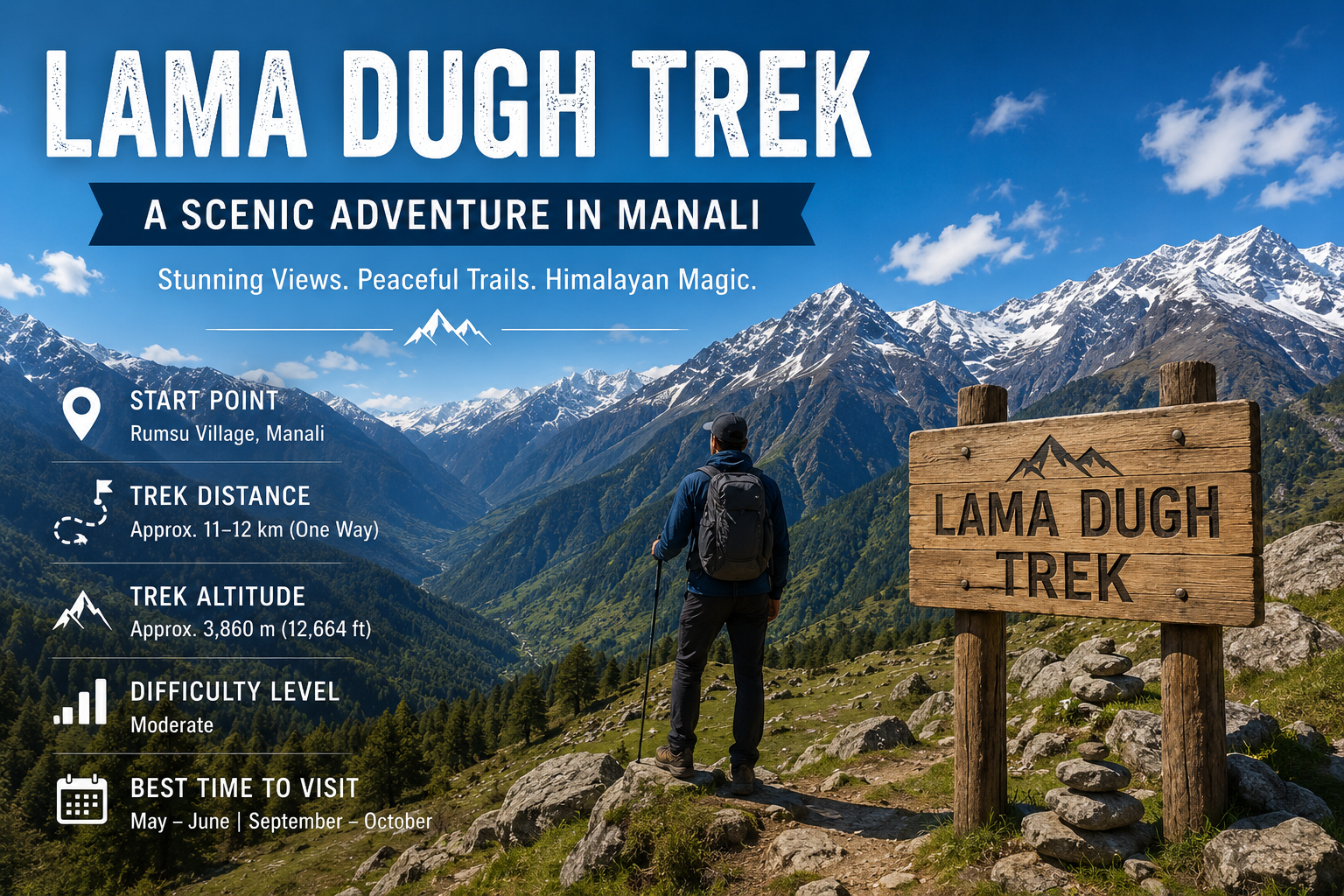
Out of Manali, the trail climbs gently, through pine forest that thins as the meadows of Lama Dugh open up ahead.
Riyali Thach comes next. Then a steady pull towards Kalihani base camp, where the trek starts asking more of you. Kalihani Pass itself is a grind: loose scree, thin air, legs that stop cooperating somewhere near the top.
The reward is a first proper look at the Bara Bhangal range from the summit.
Down the other side, deodar forest swallows the trail again. The only sound for hours is the Ravi river, somewhere below the campsite, all the way to Bara Bhangal village. After a rest here, the trail climbs once more, towards Thamsar Pass, before dropping through pine and birch into Palchak and finally Rajgundha.
One thing surprises almost everyone in the first few days: how often the trail crosses water. Expect wet boots at least once.
Two high passes in one trek demand good fitness and prior trekking experience. It’s best to build experience o neasier Himalayan treks before opting for Bara Bhangal trek. The Beas Kund trek is a gentler introduction to Himalayan altitude, and a fair way to test how your body handles thin air before committing to something like Bara Bhangal.
Detailed Day-Wise Bara Bhangal Trek Itinerary
Most operators follow a version of this 10-day plan.
#1. Manali to Lama Dugh– Easy start, 4 to 5 hours through forest into open meadow.
#2. Lama Dugh to Riyali Thach– The climb picks up, roughly 5 to 6 hours.
#3. Riyali Thach to Kalihani Base Camp– A shorter 5-hour day. Rest well.
#4. Kalihani Base Camp to Devi ki Marhi via Kalihani Pass– The big one: 7 to 8 hours, cresting near 4,700 m.
#5. Devi ki Marhi to Dal Marhi– A calmer 5 to 6 hour walk.
#6. Dal Marhi to Bara Bhangal– 6 hours, descending through deodar forest beside the Ravi.
#7. Rest day at Bara Bhangal– No walking today. Just the village, its people, and sleep.
#8. Bara Bhangal to Marhi– 6 hours towards the base of Thamsar Pass.
#9. Marhi to Palchak via Thamsar Pass– The hardest day: 8 to 9 hours, topping out near 4,875 m.
#10. Palchak to Bir-A long, satisfying descent, 5 to 7 hours, ending near the paragliding cliffs.
Add a Manali arrival day and a Bir departure day, and most itineraries stretch to 11 or 12 days.
Bara Bhangal Trek Difficulty
Let’s be honest. The Bara Bhangal Trek difficulty rating is high, and most operators classify it as “difficult” or “challenging” without hesitation.
Two passes above 4,700 metres in a single trip will test anyone. Long walking days, often six to nine hours, don’t help. Nor does weather that shifts without warning near the top. Some operators ask for a medical fitness certificate before they’ll take a booking. Take the hint.
Who Can Do Bara Bhangal Trek?
This trek is best suited for trekkers who have already earned their high altitude trekking experience. Anyone who hasn’t crossed 4,500 metres before probably shouldn’t make Bara Bhangal their first Himalayan trek.
A rough benchmark: Being able to jog 5 km in under 30 minutes, or walk 10 km on flat ground without struggling. If you can comfortably do that, then you can think of this trek.
Newer trekkers shouldn’t rule themselves out forever. Build your experience gradually. The Beas Kund trekis a much easier introduction to high-altitude trekking. It helps you get comfortable with altitude, pacing, layering before taking on something as demanding as Bara Bhangal.
Best Time for Bara Bhangal Trek
June to mid-October is the best time for Bara Bhangal Trek. Outside those months, heavy snowfall covers the passes and shuts the route down.
Go in early June, and the trail is often quiet, though still cold in the mornings. Monsoon brings green hillsides but also swollen streams and slippery scree – not ideal with two high passes to cross. From Mid-September to October,the weather is more stable and provides you with the clearest skies. That’s why many experienced trekkers prefer Autumn for Bara Bhangal Trek.
Altitude Profile
Manali is at around 2,050 metres. This makes it comfortable to begin the trek. From there, the trail rises in two dramatic spikes: first at Kalihani Pass (roughly 4,700 to 4,830 m), then again at Thamsar Pass (roughly 4,800 to 4,875 m).
Between the two, Bara Bhangal village drops back to around 2,550 to 2,900 metres. This drop in altitude gives the body a real chance to recover before the second climb.
Fitness Requirements
Give it at least eight weeks.
- Run or brisk-walk 5 km, three to four times a week.
- Add stair climbs or hill repeats for leg strength.
- Carry a loaded backpack on weekend hikes.
- Stretch regularly. Flexibility helps more than most people expect on steep descents.
Permits
Forest permits and camping charges apply along the route. Almost every operator arranges these, but confirm it before you book. Foreign trekkers usually pay higher fees than Indian nationals. Keep a valid photo ID handy, as forest checkpoints may ask to see it.
Accommodation
You will spend most nights in a tent, twin or triple-sharing, with one or two hotel nights in Manali before or after the trek. Bara Bhangal village has no guesthouses, so even on the rest day, you will continue camping.
Food
Meals are usually covered from the first lunch to the last breakfast. Dal, rice, chapati, seasonal vegetables, and something hot after a cold evening.
Pack a few extras too: nuts, energy bars, electrolyte sachets. Worth every gram on pass days.
Water Availability
Streams and springs appear often in the first half of the trek. Near both passes, though, water sources become limited.
Fill up before Kalihani Pass and Thamsar Pass – at least 2 litres each time. A small filter or purification tablets are worth the extra weight.
Packing List
-
Sturdy, broken-in trekking boots
-
Layered clothing: thermal base, fleece, down jacket
-
Waterproof shell jacket and trousers
-
Woollen cap, gloves, and a sun hat
-
Trekking poles
-
Headlamp with spare batteries
-
Sleeping bag rated for sub-zero temperatures
-
Sunscreen, sunglasses, and lip balm
-
Personal first-aid kit and regular medication
-
Power bank – there’s nowhere to charge anything once Manali is behind you
Read Also: Beas Kund Trek 2026
Weather
Daytime temperatures generally sit between 10°C and 20°C lower down, dropping close to freezing at the passes. Nights can dip below zero even in peak summer. Don’t let the season fool you into packing light.
Weather near Kalihani and Thamsar can turn in an hour. A clear morning sky guarantees nothing by afternoon. That’s exactly why guides push to cross both passes early.
Safety Tips
-
Acclimatization properly. Don’t rush the first few days of the trek.
-
Watch for altitude sickness such as headache, nausea, dizziness.
-
Cross both passes in the morning, before the weather starts to change.
-
Trek with an experienced guide who genuinely knows this route.
-
Share your itinerary with your family members or friends because you will be out of network coverage area for next few days.
Bara Bhangal Trek Cost
The trek cost can be around ₹50,000 and ₹85,000 per person. The total amount depends on group size, duration, and what the package includes.
This usually covers permits, camping gear, meals on the trail, and a guide. Personal equipment, travel insurance, and getting to Manali are typically extra. Read the inclusions list carefully before paying anything.
Read Also: Mount Japfu Peak Trek, Nagaland
How to Reach Bara Bhangal Trek
Manali connects easily by road from Delhi and Chandigarh. Bhuntar airport near Kullu is the closest flying option, about 50 km out. Joginder Nagar has a railway station too, though most trekkers simply book an overnight bus or private car from Delhi.
Bara Bhangal Trek from Manali
Take rest in Manali for one or two days before you start your trek for Bara Bhangal. Rest, and let the body adjust to altitude before the real climbing starts.
Most groups meet the evening before departure for a briefing and equipment check. Don’t skip it, even with prior trekking experience. Local guides know things about this route that general experience won’t teach.
Responsible Trekking Tips
-
Carry back everything non-biodegradable. There are no bins out here.
-
Skip single-use plastic bottles. Bring a reusable one instead.
-
Ask before photographing people in Bara Bhangal village.
-
Stay on marked trails so the meadows don’t erode further.
FAQs
Q1. Is the Bara Bhangal Trek difficult?
Yes, genuinely. Two passes above 4,700 metres and long daily walks. Come with prior high-altitude experience.
Q2. How many days does the Bara Bhangal Trek take?
Most itineraries run 9 to 12 days, factoring in travel from Delhi or Chandigarh at either end.
Q3. What is the Bara Bhangal Trek cost?
Somewhere between ₹50,000 and ₹85,000 per person, depending on the operator and group size.
Q4. Is there network coverage on the trek?
Barely any, once Manali is behind you. Let people know your schedule before you lose signal.
Q5. Can beginners attempt the Bara Bhangal Trek?
Not a great idea. Save this one until at least one trek above 4,500 metres is already behind you.
Q6. What permits are needed for the Bara Bhangal Trek?
Forest entry and camping permits, arranged by the operator in almost every case.
Q7. Which is better, starting from Manali or Bir?
Manali is the standard direction. It builds trekkers up gradually before the tougher stretch into Kangra.
Conclusion
The Bara Bhangal Trek demands good fitness, patience, careful preparation etc.
Standing on Thamsar Pass with the Kangra valley spread out below is a moment you will remember long after the trek is over.
Train properly. Pick the season with care. Go with people who know Kalihani and Thamsar well. Do that, and the Bara Bhangal Trek becomes the one you keep talking about, long after the blisters heal.