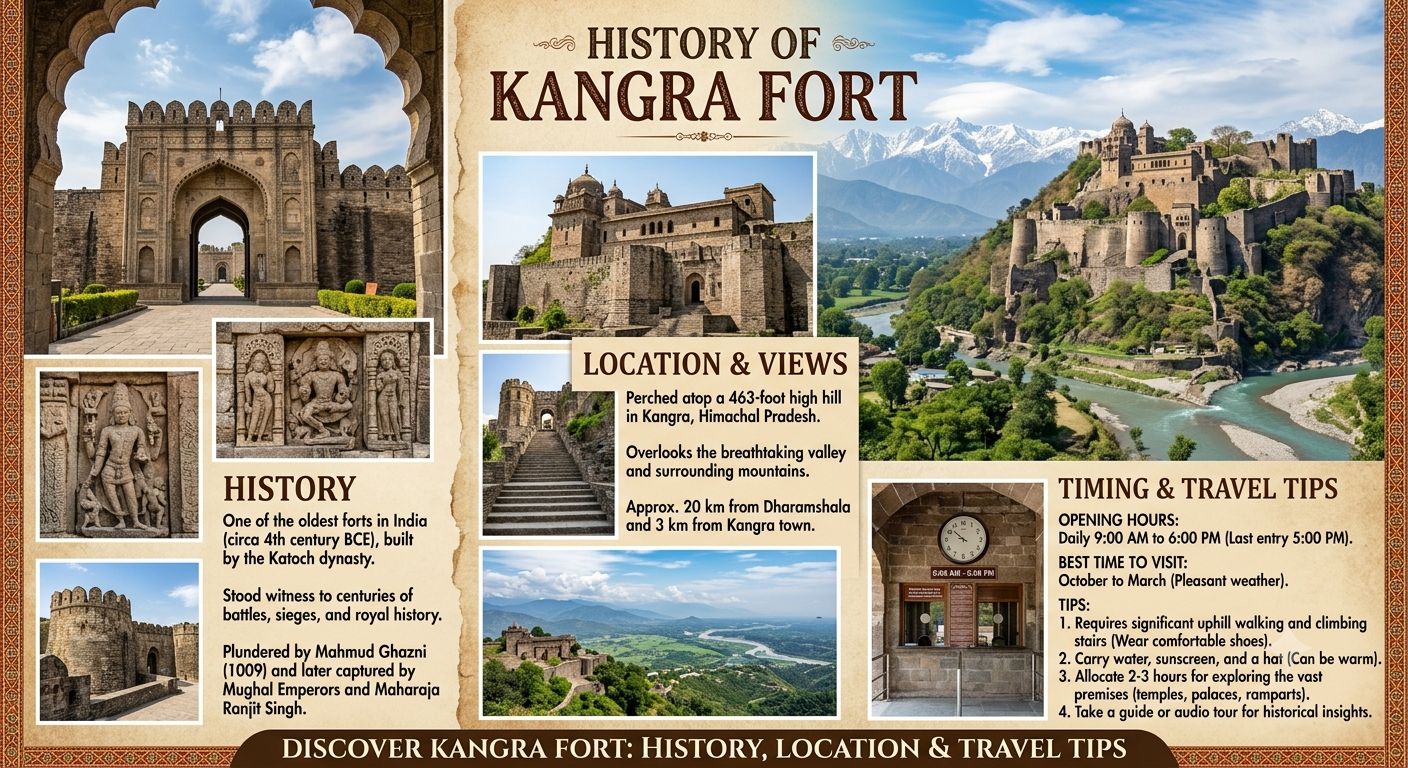
In the shadows of mighty Himalayas rest a historical fort that has witnessed years of invasions, ruling and weathering. Kangra fort, or Nagarkot fort. This fort has been ruled by Katoch dynasty for years. Its wealth has been a major attraction force for many invaders and interest for many rulers. Not only that, it’s resilience can be seen by devastating earthquake and plundering. The history is so rich here, that one day cannot cover everything.
This fort was built overlooking Manjhi and Banganga river. A strategical position that attracted many rulers to assimilate this hill fort into their territory anyhow. The most famous invading is done by Mahmud of Ghazni that has surprised this fort with a siege and captured it. Although there wasn’t an official name for who the ruler at the time invading happens. But the local records say Jagdish Chand Katoch was ruling this fort.
Today much of the fort lies in ruin with its wall weathered subsequently. But have seen my glories, because of that it is considered as one of the oldest fort in India. Its temples, walls, carvings, and foundations tell a story of the place that was once one of the most important strongholds of the western Himalayas.
Location
Kangra fort is located in Kangra district of Himachal Pradesh. It is strategically located on the elevated hills surrounded by Manjhi and Banganga rivers. The fort is in the shadows of DhaulaDhar mountains and overlook the plains of Kangra valley. Its natural surroundings played an important role in making it a formidable defensive stronghold.
- District- Kangra
- State- Himachal Pradesh
- Country- India
- Nearest town- Kangra
- Setting- The fort stands on the hill at the confluence of the Banganga and Manjhi rivers overlooking the Kangra valley.
- Distance from Dharmshala- About 20 Km
- Geographical setting- At the foothills of Dhauladhar range
Kangra Fort through ages
The earliest history of Kangra fort is difficult to separate from legend and tradition. Historically it is connected with Trigarta empire, that has been mentioned in Mahabharat. Nagarkot Fort- as known in the historical texts- became a major attraction for invaders for its wealth, location and territories. It became a prize sought out by many rulers.
Historical accounts of Kangra
In ancient times, Kangra was known by names such as Trigarta and Nagarkot. The region occupied an important position between Himalayan mountains and the plains of Northern India. This fort has deep connection with Katoch dynasty, and according to the Katoch tradition, the dynasty trace back its origins to the ancient Trigarta ruler.
Temples around Kangra attracted pilgrims and accumulated wealth, making the area both culturally important an economically important. During the 17th century, the Chinese traveller Hiuen Tsang travelled through northern India during the reign of Harshvardhan period. According to his observation, the Kangra was brought under Harshvardhan rule.
Mahmud Ghazni’s invasion
The most famous events of Kangra fort’s history was the invasion done by Mahmud of Ghazni in 1009 CE. The wealth accumulated by Nagarkot and the surrounding temples became the point of attraction for Mahmud Ghazni. According to the records, Mahmud defeated the Kangra ruler, captured the Kangra fort, and plundered the temple’s wealth including gold, silver and jewels.
Despite the invasion, Kangra continued to exist as an important hill kingdom. It is worth noting that the contemporary accounts of Mahmud’s expedition do not clearly establish the personal name of the Kangra ruler at the time.
Medieval Kangra
This period can be considered as the most turbulent ear for the Medieval Kangra. The fort seen repeated invasion and attempts by larger powers to establish control over its strategically important fort. Even after the Mahmud’s invasion, the fort remained largely under the local rulers. The strengths of the mountains allowed the local kingdom to remain considerably independent even when powerful empires controlled much of the northern India.
Firoz Shah Tughlaq
In 1306, Sultan Firoz Shah Tughlaq led an expedition towards Kangra. According to official accounts, the Raja of Kangra submitted to the Sultan and was allowed to retain his territories. But the temples still couldn’t be spared, they were plundered again.
This contest shows an important feature that the outside powers could force the local rulers to submit, but maintaining a permanent control over the mountainous region was considerably difficult.
The Mughal Period
In the 16th century, Akbar tried to bring the Kangra region under Mughal Authority. Kangra fort itself proved extremely difficult to capture. A major Mughal attempt was made in 1615, when Mughal forced laid a siege to the fort. But the records says the attempt failed because of disputes among the Mughal commander and local allies.
Emperor Jahangir however, brought the fort under his control in 1619-1620. After its capture the fort remained under direct Mughal administration for more than a century.
Return of Katoch rulers
When the Mughal power was weakening in the northern India, the local rulers saw that as an opportunity to regain the independence over the fort. The Kangra fort changed hands from one ruler to another in this small period. But the fort was eventually captured by the Sikh Chief- Jai Singh in 1774, which was later surrendered to Raja Sansar Chand Katoch in 1780. The return of the fort to Sansar Chand Katoch was a major moment in Katoch history.
Raja Sansar Chand II
Raja Sansar Chand Katoch became a celebrated king of the Kangra fort and surrounding areas and later on the most important ruler. Just after his accession, Raja Sansar Chand expanded his influence across the hill states, he reached a level of authority and prestige that no Katoch ruler had ever achieved.
His reign is also important culturally because Kangra became an important center of art, particularly the famous Kangra School of Miniature Paintings. Because of the decline of Mughal power, the patronage also declined and encouraged the artists to seek new courts. In the middle of that, the Himalayan Kingdom provided them with protection and patronage.
The Gurkha Invasion
When in 1805, Sansar Chand attacked the hill state of Bilaspur, the later sought assistance from Gurkha forces, who crossed Sutlej and entered Kangra. The Gurkha forced defeated Raja Sansar Chand’s forced and occupied large part of the hill states.
Sansar Chand was unable to defeat Gurkha forces alone, so he seek help from Maharaja Ranjit Singh, the powerful ruler of the Sikh empire. In 1809 Ranjit Singh’s forces defeated the Gurkhas, forcing them to withdraw from territories. In return, Ranjit Singh gained control over Kangra fort. And with that, marks the end of independent Katoch control over the fort.
Modern Kangra
After Ranjit Singh’s death, the Sikh empire weakened. Following the first Anglo-Sikh war of 1845-1846, the territory was brought under the British rule. And the Kangra was officially passed to the British in 1846.
The British maintained a garrison at Kangra fort. However, by this time, the fort’s importance was increasingly different from what it has been during the medieval period. It was no longer the seat of an independent Himalayan Kingdom.
Kangra during the freedom movement
Kangra also have played an important role in the National movement to fight for India’s freedom. The important figure recorded in official records was the Baba Kanshi Ram, along with other local leaders. Baba Kanshi Ram became associated with the freedom movement in the Himalayan region and was given the title “Hill Gandhi” by Jawaharlal Nehru.
The end of British rule in 1947 brought Kangra into independent India.
1905 Kangra’s Earthquake
The major devastation didn’t come from invasion or continuous wars, but from the nature. On April 4, 1905 a devastating earthquake struck the Kangra region. The enormous destruction caused by the earthquake became the focal point of why Kangra fort is in ruins today.
Many of the structure that have survived centuries of warfare could not withstand the tremendous force of the earthquake. The damage was severe, the building was destroyed, monuments were in disarray, leaving the fort ruined that visitors largely see today.
The photographs preserved in the fort’s museum provide the visual record of what the complex looked like before the earthquake. With this the visitors can compare today’s fort with the photos of what the full structure of fort once.
Timings to visit Kangra fort
Kangra fort is open to visitors from 9 am to 5 pm. This fort is located 20 km away from Dharamshala and it only take 2-3 hours to fully explore the historical place. Some visitors noted that the fort management extend the time up to 6 pm during summers for better sightseeing.
The fort is best visited during morning because of the cooler temperature. But it is recommended to avoid the trip during rainy days or monsoon since the path could become slippery. March-May and September-November is considered the ideal time to visit the fort. Moreover, it also opens during winters, offering crisp views of the Kangra valley.
Travel tips for the visitors
- Wear comfortable shoes- the fort is spread on uneven ground, so it is recommended to wear comfortable shoes with good grip for your walk
- Carry water- there is considerable walking involved, so you might want to carry water bottle with you.
- Visit earlier in the day- Mornings are advisable for better view and cooler temperature to explore the fort thoroughly
- Carry sun protection- Sunglasses, hat/cap, sunscreen can be useful since the fort is majorly exposed to the sun
- Allow enough time- Spare around 1.5-2 hours if you want to explore the main area without rushing
- Check timing before leaving- the fort opens at 9 am and sometimes the timing can rearrange too so look for the current timings before you start your trip.
- Be careful around the ruins- Stay on designated paths and don’t climb on walls or restricted structure.
- Combine your trip with the nearby famous locations– the Brajeshwari temple and other historical sites can be included in the same trip.
- Respect the heritage- Don’t litter around, carve names on the walls and please show your civic sense while exploring the fort.
- Check the weather- Rain can make stone paths slippery, while summer afternoons can be quite warm. So plan your trip accordingly.
Conclusion
Kangra fort isn’t your typical “visiting the ruin fort” site. It is a living reminder of the region’s long anf fascinating history. This fort has witnesses what not, from bloodshed, to changing rules and a devastating change in the structure, but it still stand strong today. Every stone reflects a different chapter- from battles and royal ambition to religion, art and cultural tradition.
Today, Kangra fort stands not only as a historical monument but also an important part of Himachal’s cultural heritage. Visiting the fort is like walking through the pages of history, human conflict and see how time has left its mark on it. It is well preserved today, for upcoming generation to see what has conspired in the past and get knowledge through it.
FAQs
Q1. Where is Kangra fort located?
Kangra fort is located near Kangra town in Himachal Pradesh, India. It stands on elevated hill and surrounded by Manji and Banganga river.
Q2. Who built Kangra fort?
Kangra fort was built by Katoch dynasty, who has long roots connected with the ruling of Kangra.
Q3. What was Kangra fort originally called?
The fort was known as Nagarkot fort. The wider area is associated with the Trigarta kingdom.
Q4. When did Mahmud of Ghazni invaded Kangra fort?
It happened in 1009CE. He captured the fort and plundered the wealth of Nagarkot fort.
Q5. Who was Raja Sansar Chand?
He is a celebrated king of the Katoch dynasty who recovered the fort in late 18th century and was a patron of art and culture.
Q6. Is Kangra fort still standing today?
Yes. Although much of its parts were destroyed in 1905 earthquake, visitors can still see the remains of the fort.
Q7. What can visitors see inside the Kangra fort?
Visitors can see surviving gateways, temples, stone carvings, sculptures and other archeological remains.
Q8. How far is Kangra fort from Dharamshala?
Kangra fort is located at 20 km from Dharamshala.
Q9. What is the best time to visit Kangra fort?
March-May and September-November is generally considered good time to visit Kangra Fort.