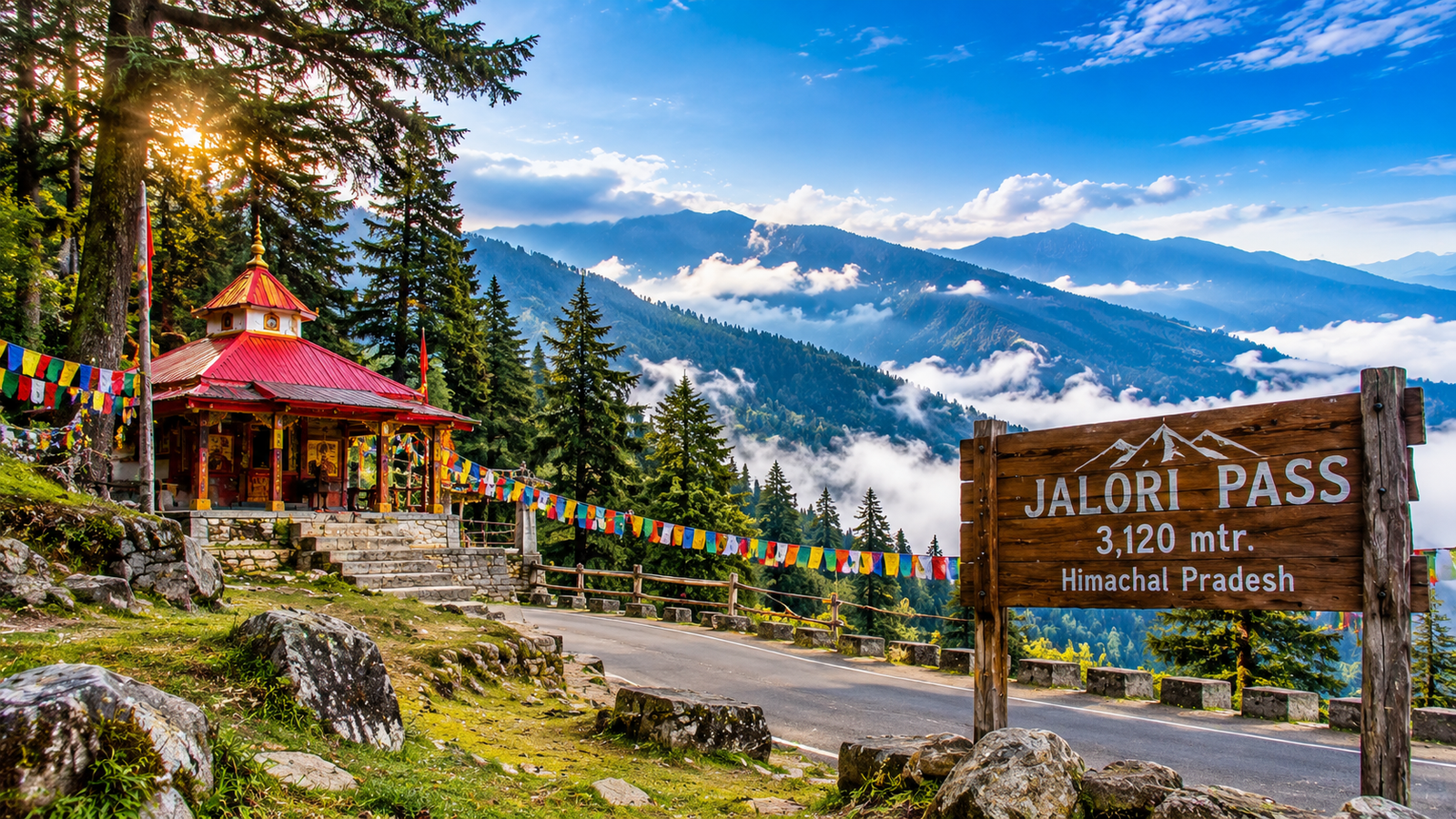
What defines Jalori Pass? High mountain roads, dense forest and a wide view of the Himalaya. Combining these two, you get Jalori Pass. It is one of the most memorable places to visit in the Banjar region. Located in Kullu district, this mountain pass connects the Banjar side with the Ani region. This offers travellers a chance to experience a quieter landscape of Himachal Pradesh.
It is one of the most famous trekking places in Kullu; it is also because of the Serolsar Lake that offers you a scenic location up in the mountain. Some come here to enjoy the mountain views and have a cup of tea at the small roadside eateries. Others visit for the trails that lead to Serolsar Lake and Raghupur fort.
The journey is as interesting as the destination. As you climb up to the trails, the surroundings change from regular village settlements to forested slopes. The air becomes colder, the roads narrower, and the landscape more open as you approach the top.
Where is Jalori Pass located?
Jalori Pass is situated in the Kullu district of Himachal Pradesh, in the Seraj region. It lies on the mountain road connecting Banjar with Ani and the areas towards Shimla. It is an important geographical crossing between the Beas and the Sutlej River catchment areas. The pass is located at an altitude of 3,120 metres above sea level.
Although it is commonly associated with Jibhi tourism, it is important to keep in mind that Jalori Pass is not located in the Jibhi village, but in Tirthan Valley. From Banjar you can plan your journey, if not Jibhi, since it has got market places, accommodation scattered around and road connectivity.
The pass is particularly known for its forest surroundings and access to two popular walking routes: Serolsar Lake and Raghupur Fort.
Why is Jalori Pass famous?
Unlike some popular tourist viewpoints that can be visited within a few minutes, this place offers opportunities to explore the surrounding landscape on foot. Jalori Pass needs preparation before setting out on your journey. To experience forested trails that eventually lead up to the cliffside where you can see the settlements down in the valley, you have to work up a bit on the trek.
One of its main attractions is the forest trail leading to Serolsar Lake. The route typically passes through thick woodland and takes visitors to a small lake associated with local religious beliefs. And if you are history enthusiast, you would want to take the trail that will lead you to Raghupur Fort, where now it’s old remains left.
The pass itself has a small temple dedicated to Jalori Mata, so don’t forget to take your blessings from here while moving up to see Serolsar Lake.
How to reach Jalori Pass
Jalori Pass is a trekking site, so you have to trek to the point. It is on you from where you start from, your starting point determine the time you reach the Pass and spend some time around.
From Jibhi:
Jibhi is the most convenient place to start your trek to the Jalori Pass. From Jibhi, you can take the road that continues to Shoja to reach the trek. The trek is approximately 12 km and will only take 40 to 45 minutes if conditions are good to reach the Pass. Make sure to wear something comfortable as the trek can be steep and with uneven walking trails.
From Banjar:
Banjar town is 19 Km from the Jalori Pass; trekkers who skipped Jibhi for their base can start from Banjar too. The town is well connected by roads, has a marketplace and options for accommodation. Banjar town will be suitable for those who want to explore wider areas around and not just Jalori Pass. The approximate time to reach Jalori Pass from Banjar is 56 minutes.
From Shoja:
Shoja is actually located close to Jalori Pass, so this base will make it a lot easier to access Jalori Pass. The visitors who are in hurry or want to reach Jalori Pass early in the morning, Shoja can become an easy path to start the hike. The road from Shoja climbs towards the pass-through forested surroundings. Because of its proximity to Jalori Pass, many visitors choose Shoja for an overnight stay and continue their hike to Serolsar Lake and Raghupur Fort the next day.
From Ani:
Jalori Pass also connects the Banjar region with Ani. This route will be helpful for those travellers who are arriving from Shimla; they can take the road through Ani to reach Jalori Pass. For travellers who have wider plans and itineraries to explore more places around Banjar or the Seraj region, this route will be easy to follow.
Trek to Serolsar Lake to Jalori Pass:
If you are not familiar with Serolsar Lake, then what are you doing? It is one of the most beautiful lakes of the region. From Jalori Pass, you can hike up to Serolsar Lake amid the forested surroundings. Many trekkers reach Jalori Pass for this lake only.
The route is approximately 5 kilometres one way, but the timing depends on the trail condition and your starting point. If you start from Banjar, it will obviously take you a lot more time than trekking from Shoja or Jalori Pass.
If you are wondering what to expect from your trek to this lake, the forested trails are waiting for you. The walk passes through dense forest, with oak and other mountain trees lining much of the route. This would result in a pleasant experience for people who enjoy nature walks and want to explore wider regions than a roadside tourist spot.
Serolsar Lake is actually associated with the local religious beliefs. A temple dedicated to Budhi Nagin stands near the lake; this place holds significant weight in the hearts of local people and devotees.
A few things to remember before the trek:
- Start early so that you have enough time to come back, especially during winter and monsoon. Always allow yourself some extra time to spare.
- Always wear comfortable shoes so it will be easy for you to trek up in the hills as the terrain is uneven and steep.
- Carry drinking water and a light snack because you won’t find anything in the middle of the forest.
- Even if the weather is pleasant in the day, it could go lower in evening time, so always carry light warm clothes with you.
- Do not litter around; the forest ground is supposed to be adorned with fallen leaves and wild flowers, not plastic wrappers and trash.
- Respect the religious importance of the lake and avoid disturbing the surroundings.
- Do not take loud speakers and throw music with loud noise please. This isn’t your private trip; many other people are coming and going through the path.
Trek to Raghupur Fort:
After Serolsar Lake, the next trail, Jalori Pass, takes you to the Raghupur Fort. Unlike the route to Serolsar Lake, this trail involves a more noticeable uphill climb. If you are a history enthusiast or just want to explore the historical remains of the place, Raghupur Fort is for you.
Although today only its remains are left behind, the surrounding landscape makes the journey worthwhile for people who enjoy hiking. While trekking, you will notice the narrow forest trails open up into a wider view of mountains and the valley.
The walk to reach here is shorter than the Serolsar Lake but it is steeper in sections. Therefore, the difficulty depends on your fitness and the condition of the trail. The advice is to carry water, warm clothes and everything you take with you on your trek to Serolsar Lake.
Best time to visit Jalori Pass:
The best time to visit depends on what kind of experience you want. For example, if you are looking for snow, winter is best for you, but if you want a comfortable trip without heavy clothes on your body, but still want to feel the chill of the mountains, spring is good to go.
March to June: Spring and Summer
This time is very suitable for people who want pleasant weather instead of heavy cold and freezing temperatures. The weather is comfortable for you to complete your sightseeing without worrying about dramatic shifts in weather. But because of its higher elevation, early spring can vary, because sometimes snow persists even after winter is gone.
July to August: Monsoon
Monsoon brings beautiful misty mountains that are covered in greenery. But the trip can be less predictable because of the weather change at higher elevations like Jalori Pass. Rain can make the road slippery; fog can reduce visibility, not to mention the risk of landslides. It is advisable not to travel during this period, but if you are, make your schedule flexible and check the road and weather conditions before setting out.
September to November: Autumn
A time when winter is at the door and the monsoon has gone by, Autumn is one of the pleasant periods to explore Jalori Pass. When the visibility gets clear, you get a picturesque view of the mountain and valley ahead. The temperature can go low even during the day so always carry warm clothing with you. The trek is really suitable at this time of the year.
December to February: Winter
Snowfall is the biggest reason why people choose Jalori Pass in winter. If you want to see winter dreamland on earth, Jalori Pass is just that. The mountains are covered in snow; the greenery is hidden behind the thick layer of white snow. But the heavy snowfall can sometimes shut down the connectivity of the road to this place. So always check the weather and road conditions before setting out on your trip.
A one-day itinerary for Jalori Pass
If you are staying in Jibhi or Shoja, you can plan your day around Jalori Pass and its nearby attractions.
Morning: Start early with your breakfast at your accommodation and begin your journey towards the pass. Enjoy the morning in the mountains while you climb up the hill.
Late Morning: you can visit the Jalori Mata Temple and spend some time around the Pass. The Jalori Pass gives you a beautiful view of the valley and forest-covered mountains ahead of you.
Afternoon: Hike up to Serolsar Lake. Since it is roughly around 5 km from the Pass, it will take you some time to walk here, so start early so that you can have time to come back and set your journey to Raghupur Fort.
Evening: you can return to your accommodation early if you want to explore Jibhi and Shoja village too. They are close to the trek so it will be easy for you to access these village in your itinerary of one day.
Conclusion:
Jalori Pass isn’t your typical trekking hillside where you can randomly select this place and think, ” Oh yeah, sounds beautiful, let’s go there tomorrow”. No, it takes preparation and meticulous planning before going on the hike. It is one of those places in Himachal that has significance for the journey as much as the destination.
This is not a place to just tick off in your checklist; the place asks for patience, a little leg strength and a whole lot of peace. Take your time, enjoy the surroundings, and experience this beautiful part of the state, which has remained underrated.
FAQs:
Q1. Is Jalori Pass open throughout the year?
No, it is not accessible all year round. Its biggest contributor is snow; heavy snowfall can cause the roads to shut down and remain isolated throughout the winter.
Q2. What is the height of Jalori Pass?
Jalori Pass is situated at approximately 3,120 meters above sea level.
Q3. How far is Jalori Pass from Jibhi?
Jalori Pass is roughly 12 km away from Jibhi, making this a convenient base for trekkers who set out on their trip to reach Jalori Pass the next day.
Q4. How far is Serolsar Lake from Jalori Pass?
Serolsar is approximately 5 km from Jalori Pass via a walking trail. The return journey requires walking the same route back, so allow enough time for the complete excursion.
Q5. Can I visit Jalori Pass in winter?
Winter visits are often difficult since the roads are cut off due to heavy snowfall. So if you are planning your trip to Jalori during winter, check the road conditions and weather before setting out.