
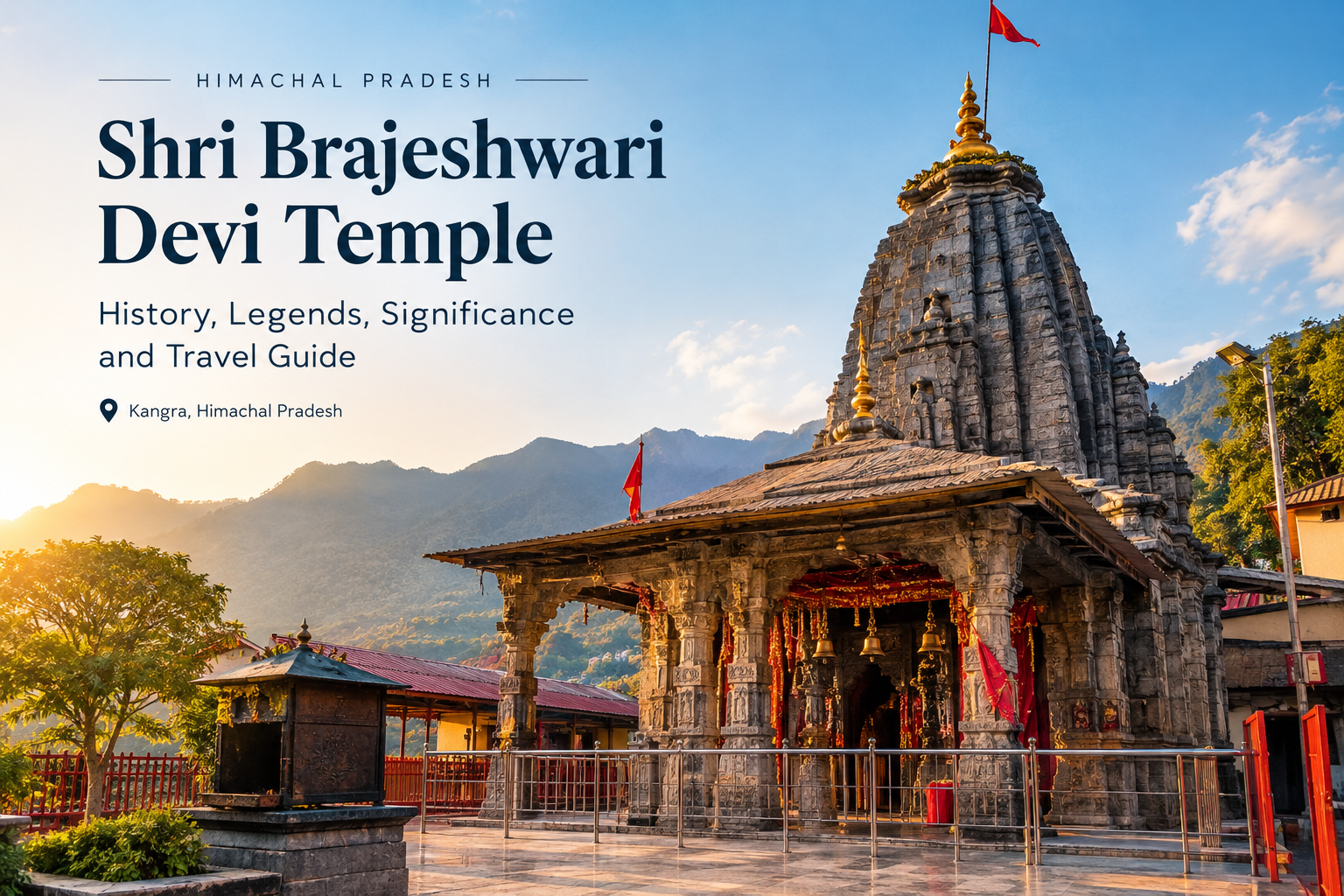
Some places are remembered for their architecture and some for their history and stories. And then there are some places whose importance goes far beyond what eyes can see. And Bajreshwari Devi Temple comes in the latter; its history and religious significance are something that fascinates tourists all the same. For generations, devotees have come to this shrine with prayers and devotion in their hearts.
Also known as Vajreshwari Devi Temple, the shrine is traditionally regarded as one of the 51 Shakti Peeth of India, making it a highly revered place. It is said that Goddess Sati’s left breast fell there. Its religious importance has made this place a significant pilgrimage destination, but there is more to the temple than its place in Hinduism. Its history is closely connected with the Kangra’s past while the devotion surrounding it continues to shape the cultural identity of its own.
First, we need to understand why this temple holds such a special place in the devotees’ hearts.
The legend that makes the Bajreshwari Devi temple sacred
The religious significance of this temple is associated with the story of Goddess Sati and Lord Shiva. The story goes that when Goddess Sati’s father insulted Lord Shiva in front of everyone, she felt rage and immense agony. Goddess Sati sacrificed herself in the pit of fire. Overcome with grief, Shiva carried her body and wandered across the universe. Seeing this, Lord Vishnu felt the disturbance in the balance of life and death, so to stop Lord Shiva, he used his divine weapon, Sudarshan Chakra, on the body of Goddess Sati to cut it into several parts. Wherever those parts fell on earth are now considered as Shakti Peeths.
Traditionally, India has 51 Shakti Peeths, and one of them is the Bajreshwari Devi temple. It is believed that her left breast fell here. For devotees, this story is not simply a tale of mythology. It represents the enduring power of Goddess Sati, the bond between the divine and the devotee and the belief that sacred places bring relief in difficult times.
A temple that has witnessed Kangra’s changing history
Kangra, as we know it, is a historically significant place in Himachal Pradesh. Its forts, settlements and the valley have seen the changing hands of rulers over the years and the destruction caused by natural calamities. Shri Bajreshwari temple forms an important part of that historical landscape of Kangra.
The temple’s past is commonly associated with periods of conflict and destruction that affected Kangra. The accounts of invasion led by Mahmud of Ghazni in the 11th and the loots happened after it-` has bled the temple internally.
Not only that, but the temple also suffered during the devastating earthquake of 1905, which has already caused widespread destruction in the region. The temple was rebuilt after the destruction, and it shows the people’s strength and devotion to restore a historical temple even after a catastrophic event.
The present-day temple, meanwhile, should not be seen as an untouched monument from a single historical period. It should be understood as a sacred site that, even after such destruction and invasion, still stands strong.
The temple and Kangra’s cultural identity
A visit to the goddess is not always planned around sightseeing and other itinerary. For the devotees, it could be a family tradition, prayer carried through whispers or a familiar part of life that brings them back to this sacred place again and again.
For families visiting from another part of the country, like Punjab or North Indian states, the journey may carry a personal meaning. Grandparents might have visited the shrine before and are now taking their grandchildren with them for the darshan. The journey might sometimes include a special family box where they all remember laughter, giggles, photos and the immense power of Devi’s blessings. Over time, such memories become a part of how families see religious traditions.
The temple is undoubtedly a place of worship, but it is also a part of the town’s shared memory. Its significance continues through the people who return, the tradition they carry with them. Shri Bajreshwari Devi temple is not simply a landmark to visit in Kangra; it is one of the places through which Kangra continues to recognise and express its cultural identity.
How to visit Shri Bajreshwari Devi temple
Shri Bajreshwari Devi temple is located in Kangra, Himachal Pradesh and can be accessed by road, air and rail. Whether you are travelling specifically for darshan or including the shrine in a wider Kangra pilgrimage, reaching the temple is relatively straightforward.
By Road:
Travelling by road is quite a convenient way to reach the temple. Kangra is connected by road to Dharamshala and other towns in Himachal Pradesh. Taxis and buses are easily accessible throughout the day. Once you reach Kangra town, the temple is around 1-2 Km from the main bus stand.
By Train:
Pathankot Junction is the option for visitors arriving by broad-gauge train. From there, you can continue your journey to Kangra by road by either bus or a taxi. Although Kangra itself has a railway station on the narrow-gauge Kangra Valley railway.
By Air:
The nearest airport is Kangra Airport, Gaggal, approximately 8-9 km from the temple. From the airport, visitors can hire a taxi or bus to reach the temple. Since the flight schedule can vary, it is recommended to check the availability first.
Temple timings and best time to visit
The temple generally opens at 5:00 AM and closes at 9 PM. The darshan timings although are 6:00 AM to 12:00 PM, then it closes for approximately 30 minutes for bhog and then reopens again for the evening darshan that is from 12:30 PM to 8:00 PM. The timing of mangal aarti is from 5:45 AM to 6:00 AM, while the evening aarti is from 6:30 to 7:30 PM.
The dress code, according to the temple authorities, should be traditional and formal wear. Photography is not allowed unless explicitly permitted. The best time to visit the temple is during Navratri and Makar Sankranti, when the temple is the most joyous and the blessings are in the air.
Tips for visitors
- Wear comfortable clothing, suitable for the temple. The temple has cited the dress code as traditional and formal wear, so adhere to the instructions before visiting the site.
- Follow the temple rules regarding footwear, photography and offerings.
- Allow extra time for darshan during Navratri and other major festivals happening in the temple, as the place could be really crowded.
- Do not litter around the temple; it is disrespectful to the deity and to the locals. Please show some manners while visiting the sacred site.
- If you have time, visit nearby Kangra fort to explore another important part of the region’s heritage.
Conclusion
Shri Bajreshwari Devi temple offers an opportunity to explore several layers of Kangra’s identity at once. It is a sacred destination associated with Shakti worship, a site connected with the region’s long and sometimes turbulent history and a place where religious traditions continue to be practised. Its story is not just related to the legend but also belongs to the people who make the journey today.
Whether you visit the temple for blessings and pilgrimage or to learn more about Himachal Pradesh’s cultural heritage, the temple provides a meaningful starting point for understanding Kangra. Its significance lies in the meeting of mythology, history and living faith, a connection that continues to give this sacred place its enduring importance.
FAQs:
Q1. Where is Shri Bajreshwari Devi Temple located?
It is located in the Kangra town, roughly around 2 km away from the main bus station. The temple offers a scared pilgrim in Himachal Pradesh, with religious and historical significance.
Q2. Is Bajreshwari Devi temple a Shakti Peeth?
Yes. Shri Bajreshwari Devi Temple is one of the 51 Shakti Peethas of India. According to a legend, Goddess Sati’s left breast fell on this place.
Q3. What does the name Bajreshwari mean?
Devi Bajreshwari is also revered as the goddess of Thunder. In another legend, the Pandavas had a dream to build the temple so that it could bless the people in the honour of the goddess.
Q4. How far is Bajreshwari Devi temple from Dharamshala?
The temple is approximately 20-25 km away by road; depending on the starting point and route, the distance can differ.
Q5. What festivals are celebrated at Bajreshwari Devi temple?
Navratri and Makar Sankranti are two of the most celebrated festivals at Bajreshwari Devi temple. The temple is decorated beautifully and many devotees visit the sacred site for blessings and offerings.
Q6. How much time should I keep for visiting Bajreshwari Devi temple?
Plan around one to two hours for darshan. You may need additional time during Navratri and other major significant festivals because of the crowd.