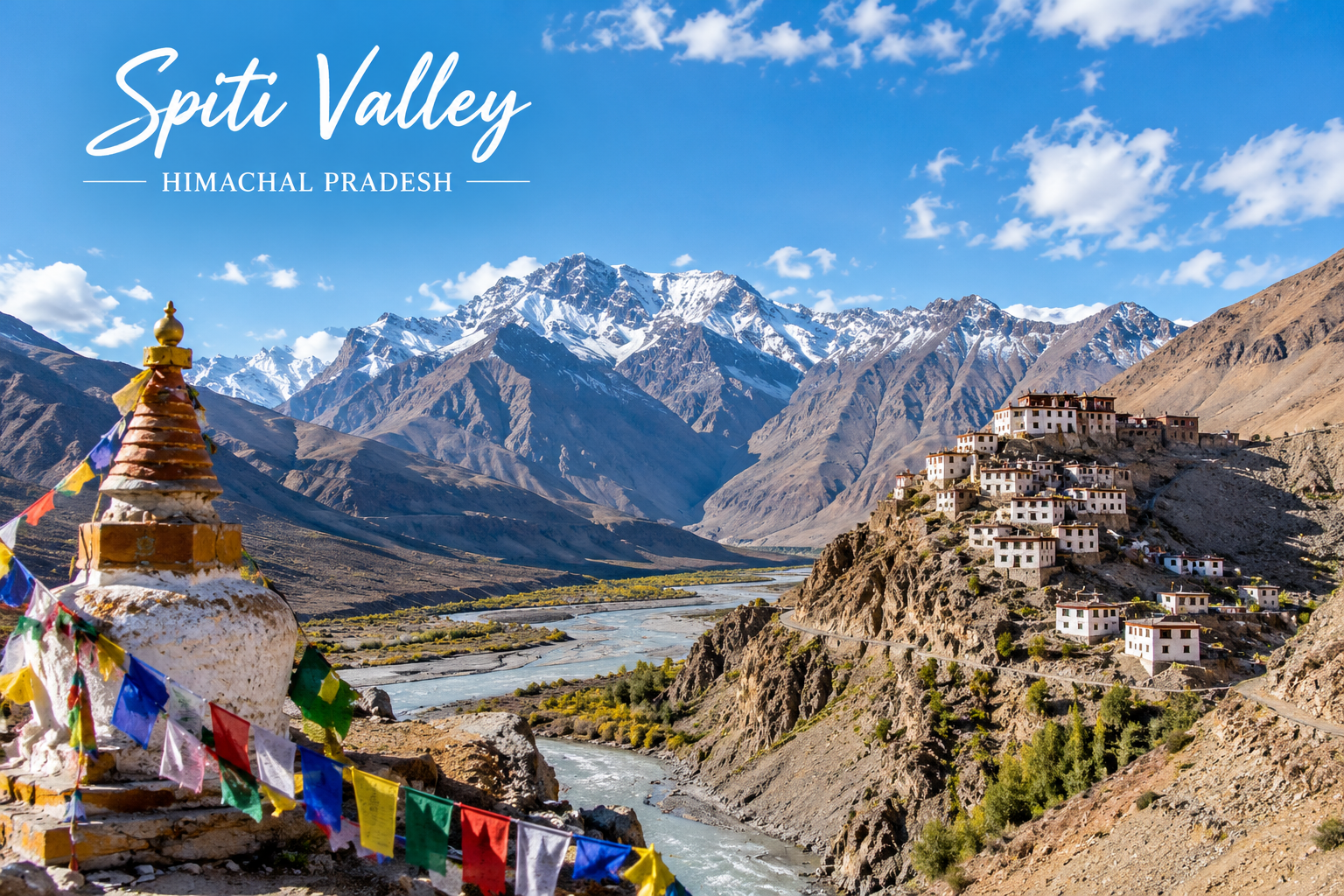
Spiti Valley isn’t your typical tourist destination you imagine it to be. It gives a refreshing view of the side of Himachal you typically won’t see. Spiti Valley is one of those places in Himachal that feels different from anywhere else in the state. Surrounded by towering mountains, barren landscapes, winding roads and small villages, it offers a glimpse of life in the cold desert of the Himalayas.
Spiti Valley showcases a strikingly different side of Himachal Pradesh, with its barren mountains, rocky terrain, and vast cold-desert landscapes standing in contrast to the state’s lush green valleys and dense forests. The mountains of Spiti appear almost untouched, and the villages seem to blend naturally into the landscape. Visiting Spiti Valley is not just about admiring mountain views or travelling along dramatic roads. It is also an opportunity to understand a way of life that has remained closely connected to local traditions and nature.
Where is Spiti Valley located?
There is a place in the Himalayas that appears bare and rugged, and in the middle, where spiritual life thrives. Spiti Valley lies in the northwestern part of Himachal Pradesh, within the trans-Himalayan region. It forms part of the present-day Lahaul and Spiti district, which combines the historically distinct regions of Lahaul and Spiti.
Surrounded by towering Himalayan peaks, Spiti Valley features rugged mountains, sparse vegetation, and occasional green patches that highlight the unique beauty of this high-altitude cold desert in Himachal Pradesh. Its geographical setting has influenced almost every aspect of local life, from agriculture and architecture to transportation and cultural exchange.
The Spiti River is one of the most important geographical features of the region. Flowing through the valley, it eventually joins the Sutlej River near Khab in Kinnaur. Kaza is the main administrative centre of the Spiti subdivision and one of the principal settlements in the valley. Several small villages dot the mountainous landscape of Spiti Valley, tucked into remote valleys and hillsides where traditional Himalayan life continues amid the rugged terrain.
History of Spiti Valley:
For centuries, communities in the valley developed their own systems of local administration while maintaining cultural and religious connections with areas beyond the mountains. Located along historic Himalayan routes, Spiti Valley has developed a rich cultural heritage influenced by Buddhist traditions, Tibetan connections, and centuries of interaction with neighbouring mountain communities.
However, the valley’s traditional villages and long-established agricultural practices demonstrate how communities adapted to its high-altitude environment. Spiti’s location also allowed it to participate in cultural and commercial exchange across the western Himalayas.
The growth of Buddhism in Spiti:
Buddhism became one of the defining influences in Spiti’s cultural identity. Monasteries developed as places of worship, education, meditation and the preservation of religious knowledge. These monasteries are more than places of worship; they serve as important centres of religious learning, cultural heritage, and community life in Spiti Valley. They also helped maintain connections between communities, supported the transmission of Buddhist teachings, and preserved valuable collections of manuscripts, paintings, sculptures and ritual objects.
Tabo Monastery, founded in 996 CE, is among the most significant historical religious sites in the region. Its murals, sculpture and historic temples provide an important record of the development of Buddhist art and religious learning in the western Himalayas.
Spiti under local rulers:
For centuries, Spiti was governed through a traditional system in which a hereditary local official known as Nono played an important role. The Nono held an important position in Spiti Valley’s traditional administrative system and played a significant role in local governance. Spiti also experienced conflict and incursions with neighbouring powers, particularly Kullu and Ladakh.
Control over mountain routes and strategically positioned settlements could carry considerable political and economic importance. The difficult terrain made governing the region from a distance challenging.
Dhankar holds historical significance for its connection with Spiti Valley’s traditional system of local administration and governance. Its dramatic position above the Spiti River made it strategically useful, and its monastery complex was historically connected with the valley’s ruling authority.
Landscape of Spiti Valley:
The landscape of Spiti is one of the most recognisable features. In contrast to Himachal Pradesh’s lush green valleys, Spiti Valley features rugged rocky terrain, steep mountain slopes, dry river channels, and limited vegetation, giving it a distinctive cold-desert landscape.
The region’s high altitude and limited rainfall create conditions typical of a cold desert. The surrounding mountains restrict the movement of moisture, while long winters and a short growing season influence the natural environment.
Why is Spiti Valley called a cold desert?
A cold desert is a region that receives limited precipitation and experiences cold conditions, especially during winters. Spiti lies in the shadow of the Himalayas. As monsoon winds move across the Himalayas, they lose much of their moisture on the southern slopes, leaving Spiti Valley with very little rainfall and a dry, cold-desert climate. As a result, Spiti receives considerably less rainfall than any other part of Himachal Pradesh.
The temperature in the valley can fall below freezing point during winter, and the high altitude contributes to cold nights even during the warmer months. Despite the harsh conditions, the valley supports human settlements and wildlife adapted to its environment. The village often contains green agricultural fields and stands out the most against the barren surroundings.
Best places to visit in Spiti Valley:
1. Key Monastery:
Key Monastery, also spelt as Ki or Kee monastery, is one of the most recognisable landmarks of Spiti Valley. It stands on a hill overlooking the valley near the Spiti River and presents a striking sight against the surrounding mountains. The monastery is an important centre of Tibetan Buddhist learning and religious practices.
2. Tabo Monastery:
Tabo Monastery is among the most historically significant Buddhist monasteries in the region. Founded in 996CE, it is particularly famous for its ancient murals, sculptures, and traditional monastic architecture. Unlike monasteries perched dramatically on hilltops, Tabo’s historic complex sits on the valley floor.
3. Dhankar Monastery:
Dhankar Monastery occupies a dramatic position above the confluence of the Spiti and Pin rivers. Its setting on the steep slope makes it one of the most visually distinctive historic sites in the valley. Dhankar Monastery played a significant role in Spiti’s religious and administrative history, maintaining close ties with the region’s traditional rulers and serving as an important centre of Buddhist practice.
4. Chandratal Lake:
Chandratal Lake, also known as Moon Lake, is a high-altitude lake in the wider Lahaul region of Himachal Pradesh. It is a popular addition to many Spiti road trips, although it lies beyond the central Spiti Valley itself. Surrounded by towering mountains, the lake stands out for its pristine waters and peaceful natural setting.
5. Kibber Village:
Kibber village is a high-altitude village known for its traditional houses, mountain views, and proximity to important wildlife habitats. It is one of the settlements that visitors often explore from Kaza. The village provides a glimpse into the everyday life of Spiti people.
6. Langza Village:
Langza is famous for its large Buddha statue overlooking the village and the mountains beyond. The statue has become a recognisable feature of Spiti’s landscape, making the settlement a popular stop for travellers. The village is also known for marine fossils found in the surrounding sedimentary rocks.
7. Hikkim Village:
Hikkim is widely known for its post office, which is often promoted as one of the highest post offices in the world. Its remote location and limited road access make it an interesting stop on a journey through the village around Kaza.
8. Komic Village:
Komic is another high- altitude village frequently included in the trips around the Kaza region. Its open landscape, traditional buildings, and views of the surrounding mountains make it a memorable destination. The village is often associated with the Tangyud monastery, an important Buddhist institution in the area.
9. Pin Valley National Park:
It is an important protected area in the wider Spiti region. Its landscape includes rugged mountains, river valleys and habitats adapted to high-altitude conditions. The park is known for its ecological importance and the possibility of encountering rare Himalayan wildlife.
10. Kaza:
Kaza is the main town of Spiti Valley and an important base for exploring nearby villages and monasteries. It is where many travellers arrange accommodation. Compared with smaller settlements, Kaza offers a wider range of guesthouses, homestays, cafes, shops and basic services.
Things to do in Spiti Valley:
- Spend time learning about the history, art and religious traditions of Key, Tabo, and Dhankar monasteries.
- Explore village lanes, observe local architecture and learn about the daily lives of Spiti people.
- Enjoy mountain photography, early mornings and later afternoon has the best lighting to click the photo.
- On clear nights, away from city lights, Spiti offers a clear sky of stars that offers you an excellent opportunity for observing stars.
- Learn about Fossils and geology in the Langza village and get to know about the evidence of a sea that once was between India and Eurasia.
- Visit local cafes and homestays to learn about regional dishes and have the opportunity to taste the local delicacies.
- Take a road trip through the mountains, especially if you are travelling with your private vehicle.
Best time to visit Spiti Valley:
Summer: May to June- summer is the beginning of the main travel season for many visitors since the temperature becomes more manageable during the day.
Monsoon and Early Autumn: July to September- Spiti receives less rainfall in the monsoon season, making it accessible to visitors. Where September could be really appealing to those who prefer light cold and lesser crowd that summer rush.
Autumn: October- October brings clear skies and beautiful mountain views, but the temperature can drop noticeably, especially at night. Travellers should be aware of the weather conditions before planning their trip.
Winter: November to March- winter transforms Spiti into a much colder and more demanding destination. Some villages may become isolated for periods, and facilities might be limited as well.
How to reach Spiti Valley:
Via Shimla and Kinnaur: the route through Shimla and Kinnaur passes through places such as Narkanda, Rampur, and Reckong Peo before continuing towards Nako, Tabo and Kaza. When the road via Manali and Kunzum Pass is inaccessible, this route can provide an alternative way to reach Spiti Valley.
Via Manali and Kunzum Pass: the route from Manali approaches Spiti through the high mountain terrain around Rohtang and Kunzum. It offers dramatic scenery but is highly seasonal. Before travelling along this route, check the latest updates from local authorities and transport operators to confirm road conditions and accessibility.
By Air: Spiti Valley does not have its own commercial airport. However, Bhuntar Airport in Kullu can be a more reasonable option if you are travelling via the Manali route.
By Train: There is no railway station in Spiti Valley either. Travellers arriving by train can consider stations such as Chandigarh or Kalka, depending on their onward route and transport arrangements. From the railway station, the remaining journey involves road travel through mountainous terrain.
Travel Tips for Spiti Valley:
- Spiti’s altitude can cause acute mountain sickness, so you need to acclimatise properly. Avoid strenuous activities after arriving at high altitude.
- You need to carry warm clothing, since evenings and mornings can be cold.
- Check road conditions. This is an important thing to check because mountain roads can close with little notice because of snow, landslides, rockfalls and repairs.
- Keep sufficient money with you. Although digital payment can work in some places, connectivity isn’t guaranteed.
- Bring your regular medicine and basic first-aid kit with you.
- Ask permission before photographing people, follow monastery rules, and avoid entering private property without an invitation.
- Avoid littering around, carry the rubbish back to the suitable disposal points, minimise plastic use and avoid disturbing wildlife.
Conclusion:
Spiti Valley is more than a destination known for dramatic mountains and adventurous road trips. Spiti is a place where the landscape, historical heritage, Buddhist traditions, and local way of life are deeply intertwined. Its ancient monasteries preserve important cultural traditions, and its landscapes reveal a side of the Himalayas that is very different from the greener mountain regions.
A visit to Spiti can be rewarding for travellers who take time to understand the place rather than rushing from one viewpoint to another. Exploring a monastery, walking through a village, sharing a meal at a homestay, or simply watching the changing light across the mountain can become some of the most memorable parts of the journey.
FAQs:
Q1. Where is Spiti Valley located?
Spiti Valley is located in the Lahaul and Spiti district of Himachal Pradesh, in the northwestern Himalayas.
Q2. What is the best time to visit Spiti Valley?
For many first-time visitors, the main summer and early autumn travel season is the most practical. However, the exact best time depends on road access, weather, and the places you want to visit.
Q3. What is Spiti Valley famous for?
Spiti is known for its cold-desert landscape, ancient Buddhist monasteries, high-altitude villages, mountain roads, fossil-bearing rocks and distinctive local culture.
Q4. Is Spiti Valley safe to visit?
You can visit Spiti safely with proper planning, but high altitude, severe cold, road conditions, and limited emergency services pose real risks.
Q5. Does Spiti Valley have an airport or railway station?
No. Spiti has neither a commercial airport nor a railway station within the valley. You can generally reach it by road after arriving at a suitable airport or railway station elsewhere in Himachal Pradesh.
Q6. What should travellers pack for Spiti Valley?
Warm layered clothes, sturdy footwear, essential medicines, a water bottle, cash, and any other necessary personal supplies.