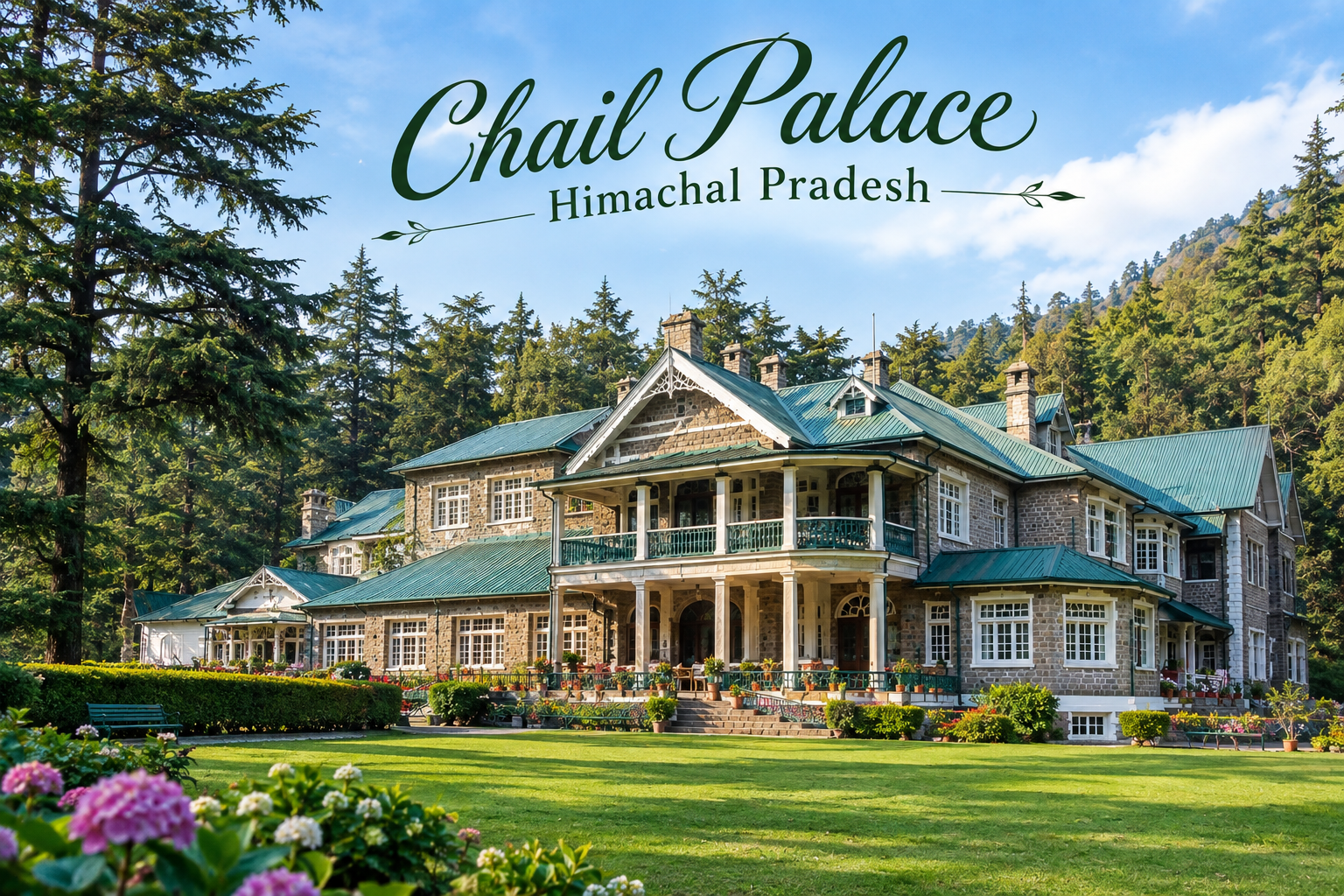
Once a summer retreat for the Maharaja of Patiala, Chail Palace is now one of the notable heritage landmarks in Himachal Pradesh. Located in Chail, in the Solan district, the palace is known for its royal history, old-world architecture, and peaceful surroundings. Whether you’re interested in the region’s history or planning a quiet getaway in the hills, Chail Palace offers an opportunity to explore a different side of Himachal Pradesh.
The attractions that beautify this place are not just the mountains and gigantic trees but the heritage left by previous generations. Additionally, the palace is known for its old-world architecture, spacious grounds, and peaceful settings. However, there is more to it than its appearance. After Chail was made a hill station under the influence of British rule, the Chail Palace now serves as a heritage hotel, allowing visitors to experience a place that once belonged to royalty.
History of Chail Palace
The history of Chail Palace dates back to 1891, when Maharaja Rajinder Singh of Patiala began developing the estate as a summer retreat. At the time, Shimla was an important summer centre for the British administration, and Chail offered an opportunity to establish a separate royal retreat in the surrounding hills.
There is a popular story that says that the Maharaja fell out of favour with the British authorities in Shimla following a personal dispute. According to local sources, he decided to establish his own summer retreat in Chail, a location that rivals Shimla both in elevation and scenery.
The estate was developed further under his successor, Maharaja Bhupinder Singh of Patiala. He helped turn Chail into a significant summer residence for the Patiala royal family. Furthermore, the area gradually became associated with royal leisure, sporting activities, and life away from the heat of the plains.
The palace also went through major changes after India gained independence. The main building you will see today is not entirely the original structure from the 1890s. Much of the earlier palace was replaced under Maharaja Yadavindra Singh, with the rebuilt palace completed in 1951.
However, in 1972, the property came under the Himachal Pradesh government and began operating as a heritage hotel under the Himachal Pradesh Tourism Development Corporation. Its royal past remains an important part of its identity, even though its purpose has changed over the years.
Architecture of the Chail Palace
The most fascinating thing about this palace is how well it sits with the natural surroundings around it. It doesn’t stand apart from the landscape; tall trees, open grounds, and the region’s rolling hills surround it.
The palace’s architecture reflects colonial influence mixed with the character of a traditional royal residence. Its sloping roof, spacious verandahs, wooden interiors and period-style furnishings give it an old-world appearance. The design is suited to the hill climate, where cool weather and seasonal rain make sheltered spaces and covered areas particularly useful.
The heritage character can be seen in the interior of the palace. The furniture, decorative details and rooms are designed to reflect the atmosphere of a former royal residence. The accommodation includes different types of rooms, suites, and cottages, so the experience can vary depending on where guests stay. It is worth remembering that the palace has undergone subsequent changes over time. The palace retains elements associated with its royal past and colonial-era influences, although the property has undergone changes over time.
Maharaja Bhupinder Singh and Chail’s Royal Connection.
After Maharaja Rajinder Singh, his son Maharaja Bhupinder Singh took over to complete the palace work. He is considered one of the best rulers of the Patiala princely state. Maharaja Bhupinder Singh inherited the estate from his predecessor and helped establish Chail as a summer centre for the royal household.
His interest in sports, particularly cricket, also influenced the development of the surrounding area. The famous Chail Cricket Ground is a lasting reminder of this period. Built on a high, relatively flat stretch of land surrounded by forests, it is widely recognised as the world’s highest cricket ground.
During the princely period, the palace served as more than a holiday destination. It served as a place where royal family members could spend some time away from the plains. Sporting and social outings were included. This connection gives the Chail Palace historical significance.
Chail Palace today: A Heritage Hotel
Chail Palace has a different role today than it had under the Patiala rulers. Today, it operates as a heritage hotel managed by HPTDC. You can now book accommodation in the palace, suites and other units across the estate, depending on availability.
Staying here offers a different experience from choosing a conventional hotel in a busy tourist town. The setting is quieter, and the property has the character of an older hill estate, with wooden grounds and architecture connected to its past.
The accommodation option includes rooms and cottages with different layouts and facilities. Some retain a more traditional appearance, while others provide a more straightforward hotel-style experience. The exact facilities and rates depend on the room category and current hotel arrangement.
The property has:
- Dinning Facilities
- Open-air café.
- Open grounds to appreciate the scenery.
- Conference and Banquet facilities.
- Room service from 8 am to 11 pm
- Car rental services
- Beauty and Spa
- Common area
Keep a thing in mind, that a heritage hotel may not provide the same facilities as a fully luxury resort. The Palace is more about exploring the history and becoming a part of it for a few days.
Best time to visit Chail Palace:
Chail Palace can be accessed throughout the year, and it depends on when you plan your trip. The best time depends on the weather you prefer and the kind of experience you want.
March to June: Spring and early summer are a good choice for visitors who want to explore the palace grounds without dealing with the cold of winter. This time is considered a comfortable time for sightseeing, and the surrounding hills become greener as the season progresses,
July to September: the monsoon brings fresh greenery and mist to the hills around Chail. This time is almost like a fairytale in the clouds. Due to its high elevation, Chail is covered in clouds throughout the rainy season. But caution is advised as the rain can disrupt outdoor plans.
October to November: Autumn is a good season for travellers who prefer cooler weather and better visibility on the hills. After the monsoon ends, the mountains are lush green, and the best time to see it without the risk of rain is autumn.
December to February: Winter brings colder temperatures to Chail, and snowfall is possible during suitable weather conditions. A snow-covered landscape can make the palace surroundings especially appealing, but snow is not guaranteed on a particular date.
Entry fee and visiting information:
Before visiting Chail Palace, it is important to differentiate between entering the grounds for a short visit and booking a room at this heritage hotel. It depends on you, whether you are seeing this as just Chail Palace or a heritage hotel.
The entry arrangements, charges, and areas open to day visitors can change. You can confirm the availability, current entry fee and access restrictions from the official website of HPTDC. Do not assume that a ticket for the grounds includes access to guest rooms, indoor facilities or every part of the estate.
How to reach Chail Palace:
Chail Palace is located in Chail, Solan district, Himachal Pradesh. The town is connected by road with Shimla, Solan and other parts of the state.
By Road: Travelling by road is a much more convenient way to reach Chail. You can hire a taxi, bus, or just take your private vehicle. Chail is commonly approached from Shimla via Kufri or from the Solan side via Kandaghat. It is advisable to check the road conditions during monsoon before setting out.
By Train: Kandaghat is a useful railway access point for visitors travelling on the Kalka-Shimla narrow-gauge railway. From there, you can continue via road to Chail. Kalka is another option for travellers connecting from the wider railway network, followed by a road journey.
By Air: Chandigarh Airport can be a practical option for many visitors travelling from other parts of India. From the airport, you can continue to Chail by road. Shimla Airport is another possible option and is closer to Chail.
Places to visit near Chail Palace:
If you are done visiting Chail Palace, consider adding a few nearby attractions to your itinerary. Each offers a different experience, from sports history to religious sites and nature.
#1. Chail Cricket Ground:
Chail Cricket Ground is one of the best- known attractions in the area. Associated with Maharaja Bhupinder Singh’s interest in cricket, it is famous for its high-altitude setting and is widely described as the world’s highest cricket ground. The ground is associated with the military school, so public access may be restricted at certain times
#2. Kali ka Tibba :
Kali ka Tibba temple is a popular religious site near Chail. Located on a hilltop, it attracts devotees as well as visitors interested in the surrounding mountain views. It is a good addition for travellers who want to experience the religious side of the region alongside its royal history.
#3. Chail Wildlife Sanctuary:
For those who are interested in nature, Chail Wildlife Sanctuary offers a different perspective on the area’s forests and wildlife. The wider forest landscape supports a variety of birds and animals, although sightings depend on conditions and luck.
#4. Sadhupul:
Sadhupul is another place to consider while exploring the region around Chail. Known for its riverside setting and relaxed atmosphere, it can be a pleasant stop when road conditions and available time allow.
Conclusion:
Chail Palace is one of the most interesting heritage landmarks in Himachal Pradesh because of the history attached to it. From its origin as a royal summer retreat to its present role as a heritage hotel. The property reflects the changing story of Chail over more than a century.
Its value lies not only in the building itself but also in its connection with Patiala rulers, the development of the surrounding town and forests that continue to define the landscape. For travellers who want to explore a quieter, historically rich side of Himachal Pradesh, Chail Palace is a worthwhile addition to their plans.
FAQs:
Q1. Where is Chail Palace located?
Chail Palace is located in Chail, Solan. It is accessible by road from Shimla, Solan and other nearby towns and states.
Q2. Who built Chail Palace?
The original palace was commissioned in 1891 by Maharaja Rajinder Singh of Patiala. His successor, Maharaja Bhupinder Singh, further developed the Chail estate.
Q3. Can tourists stay at Chail Palace?
Yes. Chail Palace operates as a heritage hotel under HPTDC, with different accommodation options. You can stay here in a room, suite or cottage of your choice. But a heritage hotel might not provide the same facilities as a full luxury resort.
Q4. How far is Chail Palace from Shimla?
Chail is roughly 45-50 km from Shimla by road, depending on the route. The actual time varies with traffic, weather and road conditions.
Q5. Is there an entry fee for Chail Palace?
An entry fee will apply to visitors who want to explore the grounds without staying overnight.