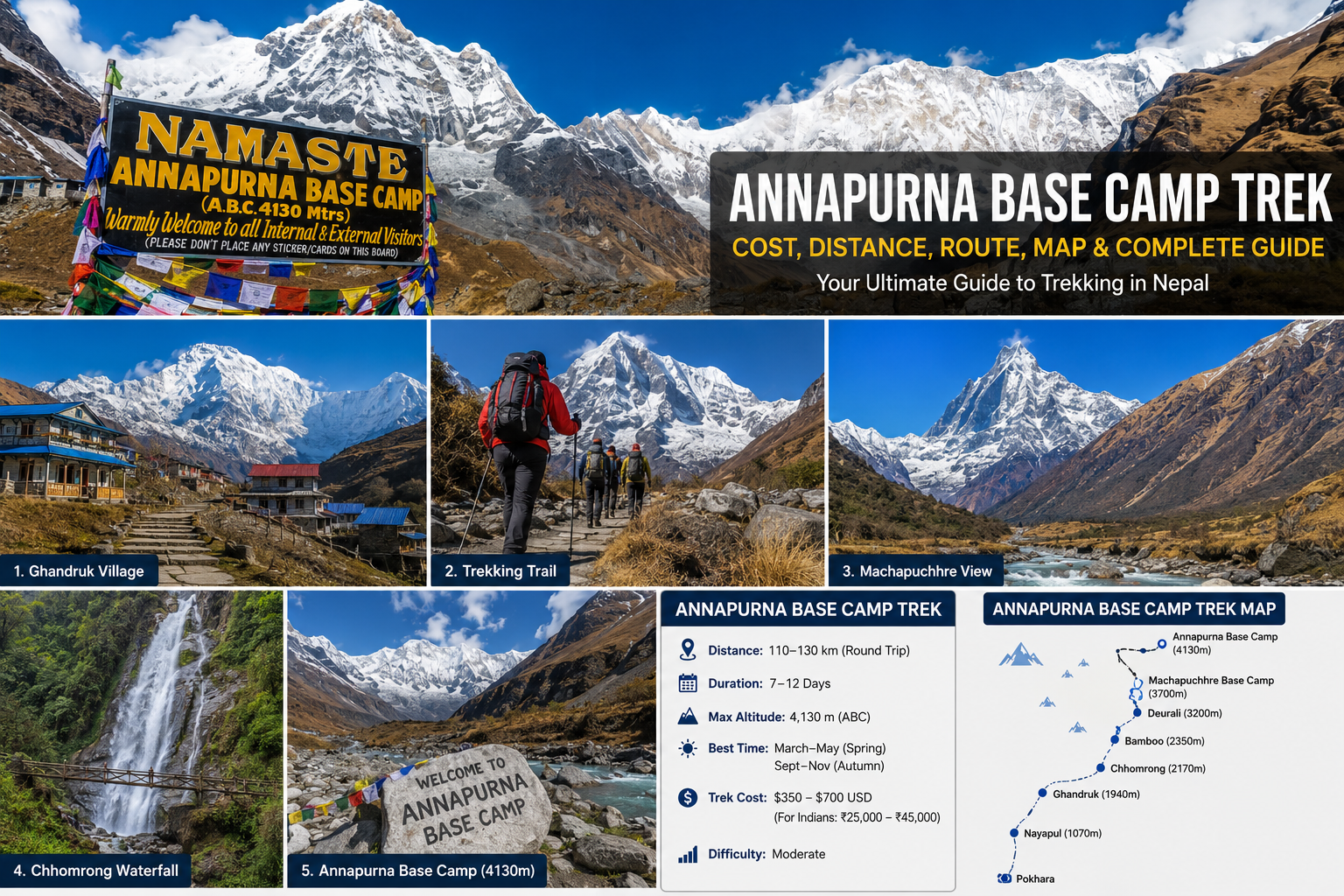
The Annapurna Base Camp Trek is popular in Nepal.
It’s great for people who are trekking for the time and also for those who have done it before.
The trail goes through rice fields, forests and villages in the mountains.
You will see peaks like Annapurna I and Machapuchare when you reach base camp at 4,130 metres.
This guide will tell you how far it is, the route you take how much it costs what permits you need the time to go and some helpful tips, for planning the Annapurna Base Camp Trek.
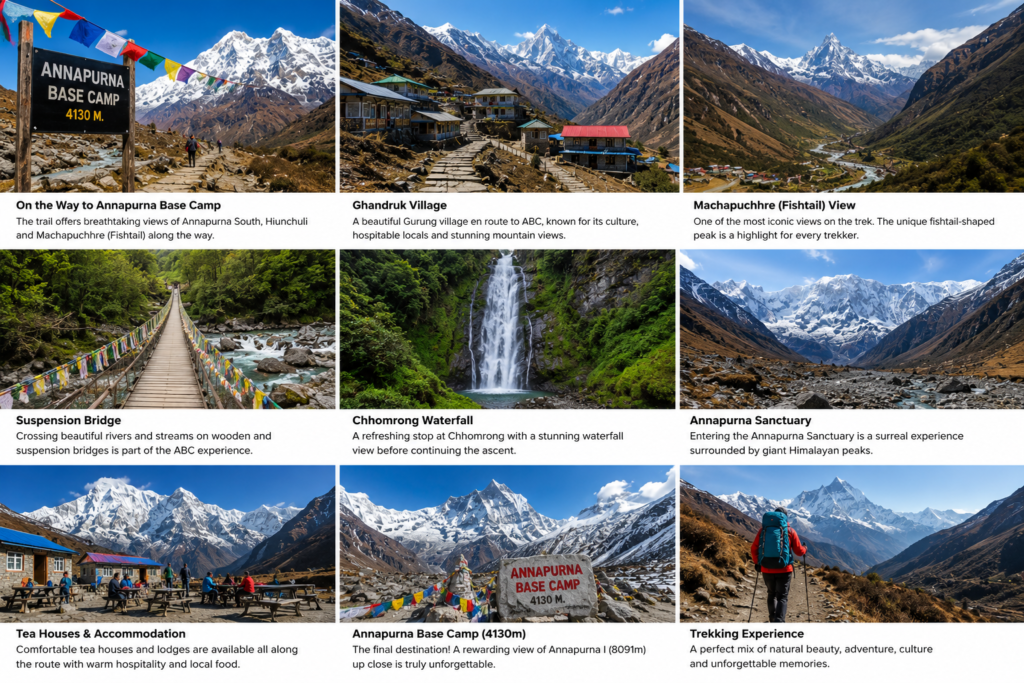
Quick Overview
- Location: Annapurna Conservation Area, central Nepal
- Duration: 7-14 days (most itineraries run 9 -12 days, including Pokhara transfers)
- Maximum altitude: 4,130 m (Annapurna Base Camp)
- Difficulty: Moderate – no technical climbing, but several hours of daily walking with steep sections
- Best season: Spring (March–May) and Autumn (September–November)
- Suitable for: First-time trekkers, solo travellers, backpackers, and families with children who walk regularly
No mountaineering experience is needed. A reasonable fitness level and a steady walking pace are enough.
Why Choose the Annapurna Base Camp Trek?
The trail takes you through rice terraces and rhododendron forest before opening into a wide mountain basin surrounded by snow-covered peaks – Annapurna I, Annapurna South, Hiunchuli, and Machapuchare.
- Tea house stays– family-run lodges, meals cooked by the same families who run them
- Local villages– Ghandruk, Chhomrong, and Sinuwa are real Gurung and Magar villages
- Changing landscape– warm forest lower down, alpine terrain near base camp
- Sunrise at base camp– many trekkers wake early to see it light up Machapuchare
Annapurna Base Camp Trek Distance
What is the Annapurna Base Camp Trek Distance? The trek covers approximately 60–70 km one way from the trailhead near Nayapul, or around 110–130 km round trip. Most trekkers walk 5–7 hours a day, covering 8–13 km daily, over 7 to 12 days.
Distance varies by route — some jeep to Ghandruk or Sinuwa to save a day, others walk the full route from Nayapul. Altitude gain matters more: above 3,000 m, avoid gaining more than about 300 m per day, and let this decide your itinerary length.
Annapurna Base Camp Trek Route
-
Nayapul → Tikhedhunga/Ulleri-A steep climb, mostly stone steps
-
Ulleri → Ghorepani/Ghandruk (route splits here) -Rhododendron forest, colourful in March–April
-
Chhomrong-The last proper village before the sanctuary; good food, Wi-Fi, your last hot shower for a couple of days
-
Chhomrong → Sinuwa → Bamboo → Dovan– Shaded forest along the Modi Khola river; occasional leeches after monsoon
-
Dovan → Himalaya → Deurali-Forest thins out, air feels different; walk slowly and monitor your body
-
Deurali → Machapuchare Base Camp (MBC)-The valley widens, your first full view of the basin
-
MBC → Annapurna Base Camp (ABC)-A short final stretch, usually timed for sunrise
-
Descent-Most trekkers return the same way, some combine this with the Poon Hill route
Annapurna Base Camp Trek Map
The trek starts near Pokhara and follows the Modi Khola valley north, through farmland and forest, into a horseshoe-shaped mountain basin called the Annapurna Sanctuary. Annapurna I sits on one side, Machapuchare on the other, with Hiunchuli and Gangapurna completing the ring. Villages on the way -Ghandruk, Chhomrong, Bamboo, Deurali — all lie along this same valley, so you’re essentially walking upstream until it ends at base camp.
Annapurna Base Camp Trek Day-Wise Itinerary
Here is a 10-day itinerary:
-
Pokhara → Nayapul → Tikhedhunga/Ulleri (5-6 hrs)
-
Ulleri → Ghorepani (5-6 hrs)
-
Ghorepani (Poon Hill sunrise) → Chhomrong (6-7 hrs)
-
Chhomrong → Sinuwa → Bamboo (5-6 hrs)
-
Bamboo → Himalaya → Deurali (5-6 hrs)
-
Deurali → MBC → Annapurna Base Camp (5-6 hrs), overnight at ABC
-
ABC → Bamboo, long descent day (6-7 hrs)
-
Bamboo → Jhinu Danda – hot springs, a good place to relax (5-6 hrs)
-
Jhinu → Nayapul → drive to Pokhara (4-5 hrs walking, plus drive)
-
Buffer/rest day in Pokhara
Annapurna Base Camp Trek Cost
What is the Annapurna Base Camp trek cost?
Total cost usually ranges from USD 500 to USD 1,200 per person for a 7–12 day trek.
- Independent budget: USD 500–650 – own permits, no guide, pay-as-you-go
- Standard guided package: USD 650–900 -guide, porter, permits, accommodation included
- Comfortable/full-service: USD 900–1,200+ – private rooms, flights, more flexibility
Guides charge USD 30–35/day, porters USD 20–25/day (one can carry two trekkers’ bags). Rooms are cheap since lodges depend mainly on food sales; meals get pricier with altitude, as supplies are carried up by porter or mule.
Annapurna Base Camp Trek Cost For Indian Travelers
What is the Annapurna Base Camp Trek Cost For Indian?
Total cost usually falls between ₹25,000 and ₹80,000 per person. SAARC nationals also get a lower permit fee.
- Permits: ACAP ~NPR 1,000 (~₹625) for SAARC nationals, versus NPR 3,000 for other foreign trekkers
- Transport: flights from Delhi, Mumbai, or other cities to Kathmandu, then onward to Pokhara – or overland via Gorakhpur to save money
- Food and accommodation: ~₹2,000-2,600 per day
- Guided packages: generally ₹35,000-₹90,000, cheaper per person in larger groups
- Independent budget: approximately ₹18,000-₹35,000
Ways to reduce cost:
trek in a group to split guide/porter charges, take the tourist bus instead of flying to Pokhara, and eat what the tea house is already preparing rather than ordering separately. Most tea houses expect meals to be ordered from them rather than outside food eaten at their tables, since that’s their main income.
Indian citizens don’t need a visa for Nepal under the 1950 Indo-Nepal Treaty, which simplifies planning.
Permits Required
Can you trek Annapurna Base Camp without permits? No. You need the Annapurna Conservation Area Permit (ACAP), and depending on current rules, a TIMS card too. Both must be arranged in Kathmandu or Pokhara before starting.
TIMS card rules have changed recently, and sources don’t fully agree on whether it’s still required. ACAP remains consistently required, checked mainly at Birethanti and Chhomrong. Since 2023, Nepal has also encouraged licensed guides on major routes, though enforcement is inconsistent. Confirm the latest requirements with a trekking agency before you travel. Documents needed: passport copies, passport-sized photos, and your trekking itinerary.
Best Time for Trekking to Annapurna Base Camp
When is the best time for Annapurna Base Camp trek?
Spring (March-May) and Autumn (September-November) offer the clearest skies and most stable weather.
- Spring: Rhododendrons in bloom, warm days, cool nights. Peak season – tea houses fill up.
- Autumn: Clearest mountain views of the year. Also peak season – book ahead.
- Summer/Monsoon: Wet trails, leeches lower down, cloud cover blocks views. Quieter and cheaper.
- Winter: Cold near ABC and MBC, but clear skies and a quiet trail.
Annapurna Base Camp Difficulty Level
The trek is rated moderate – no technical climbing, but 5-7 hours of daily walking, often on stone steps, for several days in a row. Think twice if you have an untreated heart or lung condition, cannot manage a few hours of continuous walking, or are travelling with very young children (agencies usually recommend age 10-12 minimum).
Preparation that helps: walk or hike regularly for 6–8 weeks beforehand, practise on stairs, wear your trekking shoes in advance, and keep at least one buffer day in your itinerary.
Altitude Sickness
At 4,130 m, altitude sickness is a genuine possibility, though the risk is lower than on higher treks like Everest Base Camp.
#Symptoms: headache, nausea, dizziness, loss of appetite, difficulty sleeping.
#Prevention: walk at a steady pace, drink enough water, avoid alcohol on trekking days, and don’t skip acclimatization stops.
If you get a headache above Deurali, don’t just take a painkiller and continue climbing. Take rest, and drink sufficient water. Resting a day is normal.
Annapurna Base CampPacking List
- Clothing: moisture-wicking base layers, warm fleece or down jacket, waterproof outer layer, trekking pants, thermal layers
- Footwear: trekking shoes, camp shoes, wool socks
- Medicines: personal prescriptions, altitude sickness medication (post doctor consultation), first aid kit, stomach upset medicine
- Electronics: power bank, universal adapter, headlamp with spare batteries
- Documents: passport, permits, travel insurance covering high-altitude evacuation, photocopies of documents
- Other essentials: trekking poles, sleeping bag rated to -10°C, water purification tablets or filter, sunscreen, sunglasses
Accommodation and Food
Tea houses are good accommodation option here – twin-sharing rooms, shared bathrooms lower down, fewer attached ones higher up. Room charges are low since lodges depend mainly on food sales.
Transportation
- From Kathmandu: Fly (25 minutes) or take a tourist bus (6-7 hours) to Pokhara.
- Pokhara to trailhead: Private jeep or shared vehicle to Nayapul or another starting point, usually 1-2 hours.
- Return: Vehicle transfer from Nayapul back to Pokhara, then flight or bus to Kathmandu.
Annapurna Base CampTravel Tips
-
Wear your trekking shoes for a few weeks before the trek.
-
Carry small-denomination Nepali rupees — no ATMs on the trail.
-
Start walking early, since afternoon cloud cover blocks views.
-
Trekking poles reduce knee pressure on the descent from ABC to Bamboo.
-
Carry a headlamp for the early morning walk to catch sunrise.
-
Carry cash for showers, charging, and Wi-Fi.
-
Buy travel insurance covering high-altitude trekking and evacuation.
-
A few Nepali words, like “Namaste” and “Dhanyabad,” are appreciated.
-
Carry purification tablets or a filter instead of buying bottled water.
-
Check for leeches on the Bamboo-Dovan section after monsoon.
-
If trekking solo, share your route with your guesthouse or a contact.
-
Keep a printed copy of your permits -network is unreliable above Chhomrong.
Annapurna Base Camp vs Everest Base Camp
The Annapurna Base Camp is generally easier than Everest Base Camp and suitable for many first-time trekkers – a lower maximum altitude (4,130 m vs 5,364 m), shorter duration, and no flight into a mountain airstrip. It’s also more affordable, with lower permit costs and cheaper tea houses.
Everest Base Camp involves a longer trek, higher altitude, and the distinct culture of the Khumbu region. It’s usually more crowded and more expensive, mainly due to the Lukla flight.
For first-time Himalayan trekkers, families, or budget-conscious travellers, Annapurna Base Camp is usually the more suitable starting point. Everest Base Camp suits those with prior high-altitude experience looking for a bigger challenge.
Conclusion
First few days of Annapurna Base Camp Trekking may feel difficult, but most trekkers become satisfied once they reach the wide mountain basin surrounded by peaks like Annapurna I and Machapuchare. Planning your trip early, budgeting realistically, and walking at a pace suited to your fitness level will help you complete this trek comfortably.
If you’re planning your next Himalayan trek, you may also think of Planning the Bara Bhangal Trek.
FAQs.
#Q1. Is Annapurna Base Camp difficult?
It’s moderate. No technical climbing, but expect long daily walks and steep stone sections, particularly on day one to Ulleri.
#Q2. Can beginners complete the trek?
Yes, with reasonable fitness and preparation beginners can go for this trek.
#Q3. How many days are required?
Most itineraries take 7–12 days, with 9–11 days being common for a comfortable pace.
#Q4. What is the Annapurna Base Camp Trek Distance?
It takes approximately 60-70 km one way, or around 110–130 km round trip, depending on the route.
#Q5. What is the Annapurna Base Camp Trek Cost For Indian?
Approximately ₹25,000–₹80,000 per person, with a lower permit fee for SAARC nationals.