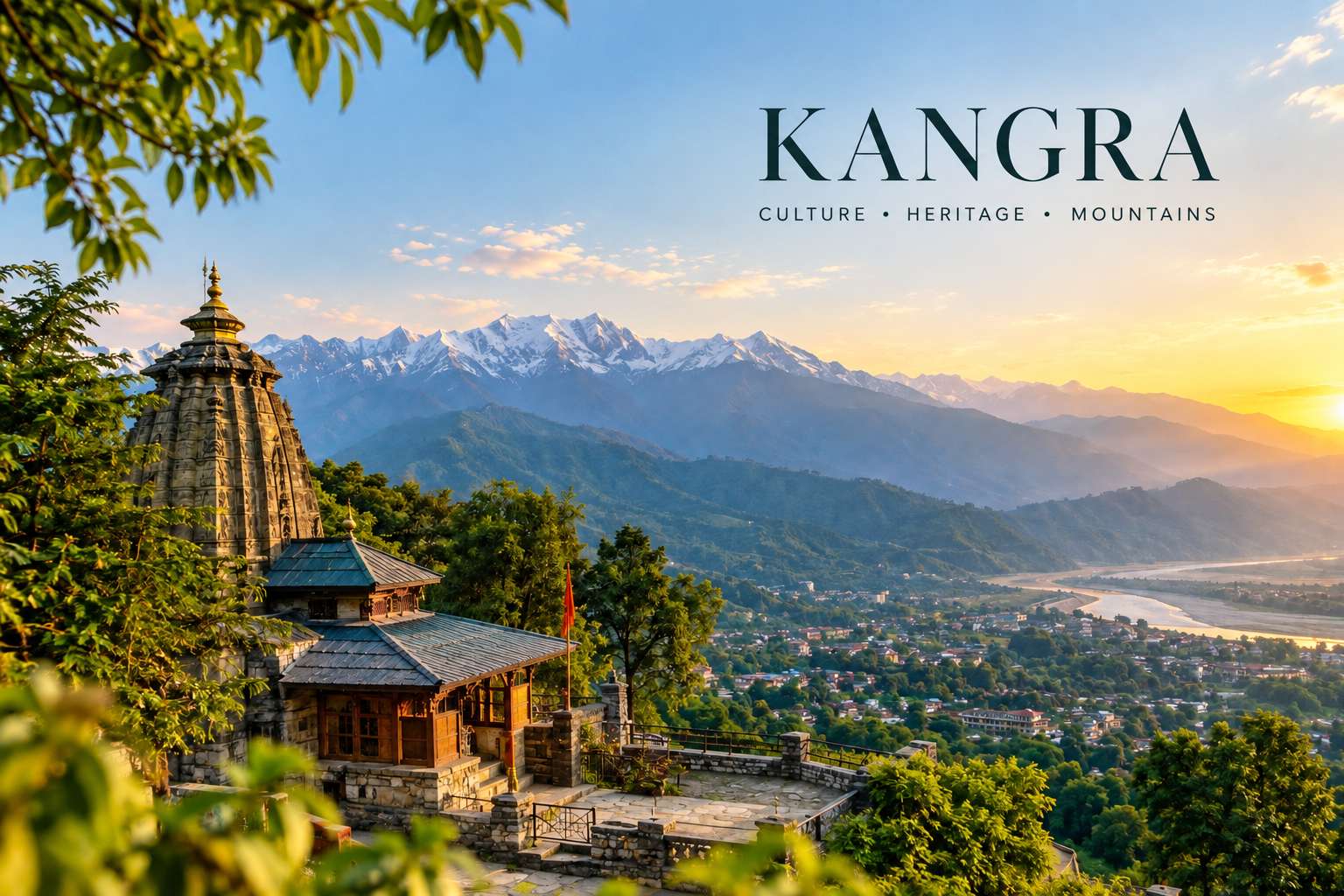
Kangra isn’t your typical hill station like Manali or Shimla. It sits quietly in a corner while people visit Dharamshala and McLeod Ganj and call in their trip. Kangra is the most populated district of Himachal Pradesh with combination of both plains and mountains living in harmony. Ancient texts referred to this land as Trigarta, and later travellers knew it as Nagarkot.
Kangra’s history stretches back centuries old. You can find it’s mention in epic texts like Mahabharat and was long ruled by Katoch dynasty. It was a state who has seen bloodshed, rise and falling of kingdom and eventually assimilating into modern today. But, beyond its marital history, Kangra is a major centre of art and faith. It gave birth to Kangra School of Miniature Paintings famous for its delicate brush work and vibrant colors, you will find yourself to be stopped by them and get immerse in its style.
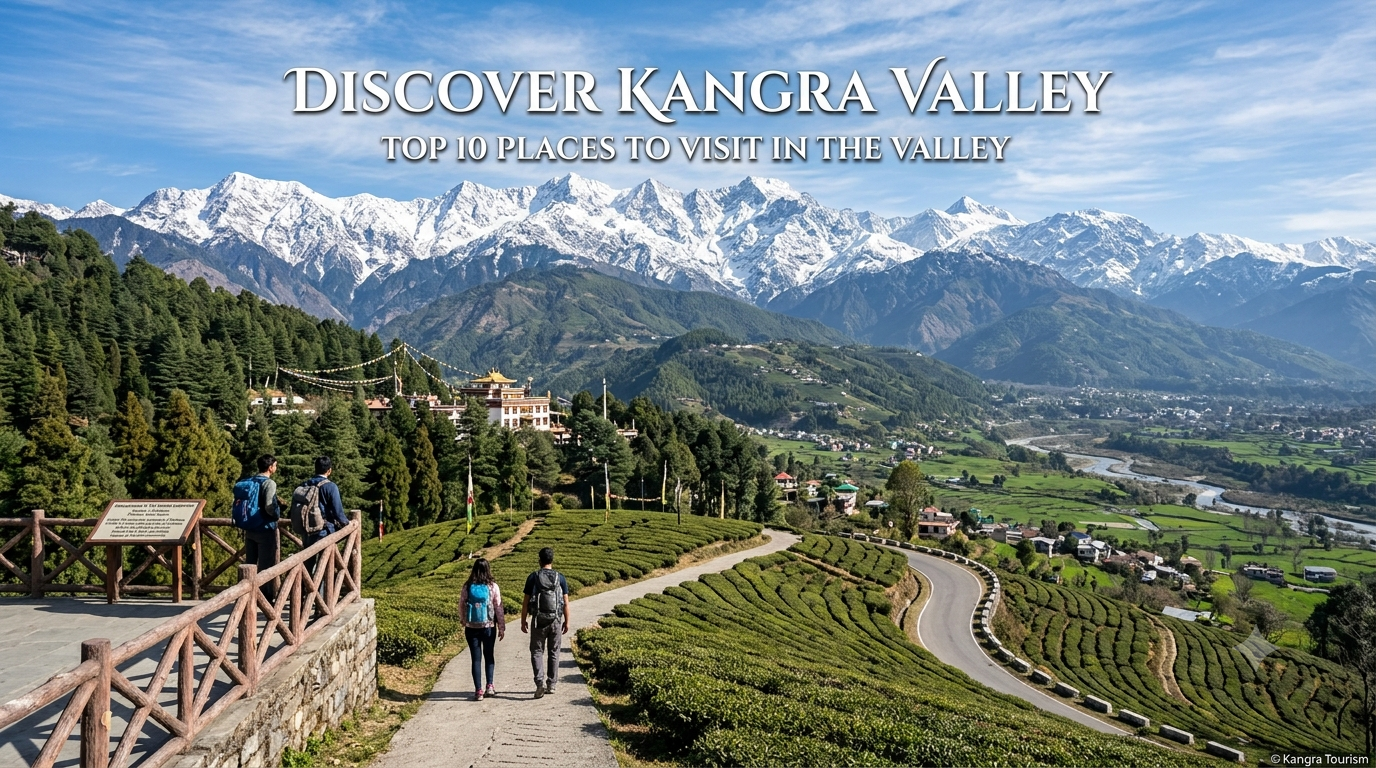
Kangra hosts major Pilgrim sites also like Brajeshwari Devi Temple, Jwalamukhi Temple and 8th-century rock-cut temples. Whether you want to trek in the forest, flower covered paths, or just simply get peace by visiting temples, it has everything in store. The valley is known to be the most beautiful valley of Himachal, where you are standing on a plain and see the majestic Dhaula Dhar ahead of you.
It also encompasses Dharamshala and McLeod Ganj, bringing a vibrant Tibetan culture into the fold as the home of the Dalai Lama. Whether you visit for its history, its spiritual sanctuaries, or simply the crisp mountain air, Kangra offers a timeless glimpse into the heart of the Himalayas. Now, let’s see what are some best places you can visit in Kangra.
1. Kangra Fort
This fort has seen what not. Built in 9th century, it is reputed as the oldest fort in India, and ruled by Katoch dynasty for the longest. Kangra fort was built on a strategical position, where it is perched up and the river Manjhi and Banganga just flow by past it. Because of that reason, it was coveted by many rulers and invaders. The wealth accumulated by this fort was so massive that from Mahmud of Ghazni to British colonisers all wanted it in their assets.
Where Akbar couldn’t take this fort, his son Jahangir won this in 1620CE. And because of that you will find many Mughal inscriptions on the walls and the Gate “Jahangir Darwaza” dedicated to this contest. Later on, it was taken control by Maharaja Ranjit Singh, and to witness that you have Ranjit Singh gate on the fort. Even after the devastating earthquake in 1905, this fort still stand strong in its remains.
It is located roughly around 20 km from Dharamshala, so if you are visiting Dharamshala, make sure to visit this historical fort and just get immerse in the beauty of it. This fort won’t disappoint you. If you are wondering about entry fee, yes, it’s not free. For Indians its 25 Rupee and for foreigners its 300. So, plan your trip accordingly but don’t try to miss it.
2. Masroor Rock cut temple
This magnificent temple can be considered as the forgotten Ellora of India. These Cluster of monolithic temples was carved out by one stone and believed to be dated around 8th century old. It is quite a mystery who built it and why it was left incomplete. Yes, it was left incomplete, these temples home the weathered idols of Shiva, Vishnu, Devi and Saura traditions of Hinduism.
It is a fantastic example of Northern Shikara architecture with a small reflecting pool in front that mirrors the temple on calm mornings, and almost nobody else will be there with you. Although only the remains have left behind after 1905 earthquake, the archaeologists says that the artist and the architecture has far more ambitious plans for this temple.
In today’s date there are 3 main gates of this temple, where two were left incomplete. The words have it, fourth gate was also in the plan but it was left incomplete too. Nobody knew why, but now all we have is the mystery of this temple with beautiful Shikhara architecture.
3. McLeod Ganj
Known as the Little Lahasa, this town hosts the Tibetan government-in-exile and known to be the home of Dalai Lama. The interesting fact of this place except for Dalai Lama, is that it was named after Sir Donald Friell McLeod, a Lieutenant Governor of Punjab during British Colonial rule in India. McLeod Ganj has the average elevation of 2082m and is located in the Kangra Valley. That means you will be in the shadow of the mighty DhaulaDhar mountains, the crown of the town.
It is a major tourist attraction; it hosts so many activities that you will forget to go home. You can spend your day visiting the main market and Kalachakra Temple, in the afternoon hunting for Pashmina and goodies and in the evening at one of the rooftop cafés watching the sun drop behind the Dhaula Dhar.
It’s especially beautiful in winters when the valley is covered in thick layer of snow. The sun shines on the snow crystals, and people giggle around in happiness. Most tourist visit this place during Christmas and New year so it can be over crowded during those seasons, so it is recommended to plan your trip according to it.
4. Jwalamukhi Temple
As the name suggest it’s “Jwala” Mukhi temple, where no idol is worshipped but an eternal flame that never goes off. It is one of the 51 Shati Peetha according to the tradition of Hinduism. The flames that burns itself is worshipped as the main Goddess there. Even Akbar reportedly tried to douse the flame during a visit and failed, according to local legend, which only added to the temple’s mystique over the centuries.
This temple is dedicated to Jwala Devi that reside there in the form of a Jwala. The Devi is considered as the Goddess of Light. As it is one of the major Shakti Peetha, it is believed that the tongue of Mata Sati has fallen here. The Tongue of sati is represented by Holy Flames or Jwala that is perpetually burning.
During March to April and September to October every year colourful fairs are held during the Navaratra celebration. During that time, the complex is decorated beautifully making it the major attraction for devotees all around the world.
5. Chamunda Devi Temple
Sitting on the banks of Banser river, surrounded by the dense deodar forest, resides Chamunda Devi. It is less mobbed than Jwalamukhi temple but just as important as it. This temple is dedicated to the fierce form of the Goddess Shakti- Durga. Moreover, it is believed that getting the blessings from the Devi will protect the devotees from unseen forces.
The legend associated with it is something we might all have listened or read somewhere. The demons Chanda and Munda were unleashing terror across the world and to stop that, Goddess Durga manifested her fiercest form- Chamunda and destroyed the demons. From there, she got the name of Chamunda.
The temple was established by Raja Umed singh of Chamba, otherwise the idol was orginally on the other place. It was ceremoniously established to the current location in 1762 CE.
6. Brajeshwari Devi temple
Also known to be as Kangra devi temple, it is dedicated to Durga in her fierce form as Vajreshwari. This is also the major Shati Peeth out of traditional 51. Left breast of Mata Sati was believed to be fallen there. The temple also home small chambers of other Hindu deities.
The name Vajreshwari comes from Sanskrit where Vajra means thunderbolt and Ishwari means goddess, collectively come to known as Goddess of Thunderbolt.
Alongside with the Mata Sati legend, another story is associated with it. The words says that, during their exile, Pandavas dreamt of Goddess Durga who told them to built her temple at Nagarkot for the protection of people and devotees. For people interested in pilgrims, this could be your best start. Shri Brajeshwari Devi not only bless her devotees but also guide them to a right path.
7. Pragpur
Interested in heritage sites? Well, this will be the perfect place to see how time has stopped at one place. State government of Himachal has declared this ornamental village as the country’s first heritage village. Founded by the Patials, this village was used to be a part of principality of Jaswan.
But now, nothing has changed, you will still see cobblestone paths, unchanged infrastructure, slate-roofed house, and old water tanks. If you want to go back in the past without a time machine, this place have your answers.
One of the most heritage place in the Pragpur is the Judge’s court. This could be considered as the oldest heritage property in Pargpur. Ironically, Pragpur got so many heritage sites, the state government said- yes, the whole place is heritage, let’s convert it into India’s first heritage village. It happened in December 1997 by the way.
8. Shri Kangra Jain Shwetambar Tirth
Alongside with Hindu Pilgrim, Kangra hosts Jainism visit sites too. And Shri Kangra Jain Shwetambar Tirth is one of them. Located just opposite the Kangra Fort, it is one of the most significant Jain Pilgrim centres in the state and is dedicated to Lord Adinath.
Kangra is regarded as the only Jain Pilgrim site in the Himachal. You can travel around Himachal and will find temples and monasteries but Jain temples? Only in Kangra. The main idol that is the major attraction for the tourists is actually in the custody of Archaeological survey of India. But the Jains are permitted to worship here.
Where Kangra is generally associated with forts, temples, monasteries and major Himalayan beauty, but the Jain heritage of the area shows that the region also had connections with Jain communities and pilgrimage networks over many centuries.
9. Archaeological Museum at Kangra fort
The museum at Kangra Fort preserves the history and roots of Kangra in well form. If you are a history enthusiast, this place is just right for you. You can visit the museum right after the Kangra fort to understand the history better.
Sitting right at the front of Kangra’s fort gate, it accommodate the pre-historic stone tools, scriptures, and historic rock inscription. It isn’t just a place to wander and see things; the museum actively encourage academic dialogues and research. With a diverse collection of Hindu and Jaina deities on display; the museum complex is no less to a modern site of archaeological and spiritual importance.
The museum is particularly useful because it places the history of Kangra Fort into a wider archaeological context.
10. Maharaja Sansar Chand Museum and Café
To know more about royal lineage of Kangra, you should visit this museum. It houses all the royal bearings, clothes, weapons, paintings and historical documents. Named after the celebrated King Sansar Chand Katoch whose reign was considered as the Golden age in Kangra. It is located near Kangra Fort in Old Kangra. This museum gives the glimpse of royal heritage.
Maharaja Sansar Chand was the patron of art and culture, so you will find many Kangra paintings there. One of the highlights of this museum is that the visitors can take break after exploring the site. The café adds a relaxed element to the experience, with food and refreshments available in a scenic setting overlooking the surrounding hills and Kangra Fort.
Conclusion
Kangra is a place that can take you into the past, throw you in the middle of nature beauty and you won’t be regretful it at all. From the historic Kangra Fort and royal museums to ancient temples, Jain heritage to temples every part of the region offers something different to explore. Its peaceful surroundings, traditional architecture and rich local culture make the journey just as memorable as the places themselves.
So whether you want a full trip or relaxed walk, Kangra offers you everything. In middle of everything you find yourself loving the place more and more and it still won’t be enough. You will be mesmerized by the majestic Himalayan mountains that you will forget to blink. So add this place in your bucket list and turn your busy life into a peaceful walk.
FAQs
Q1. What is Kangra famous for?
Kangra is famous to house iconic temples, nature walks, plains with the view of snow-covered majestic mountains and the history rich land.
Q2. What are the best places to visit in Kangra?
If you are history centric- Kangra Fort and Maharaja Sansar Chand Museum is for you. If the purpose of your trip is devotion, Brajeshwari Devi, Chamunda Devi and Jwalamukhi Temple is right for.
Q3. What is the best time to visit Kangra?
March to June and September to November are generally comfortable periods for sightseeing and outdoor activities.
Q4. What is Kangra Fort famous for?
It is famous for its rich historical significance, heritage, ancient temples and architecture.
Q5. Can Kangra be covered along with Dharamshala?
Yes. Kangra and Dharamshala are relatively close and can be included together in a Himachal Pradesh travel itinerary.