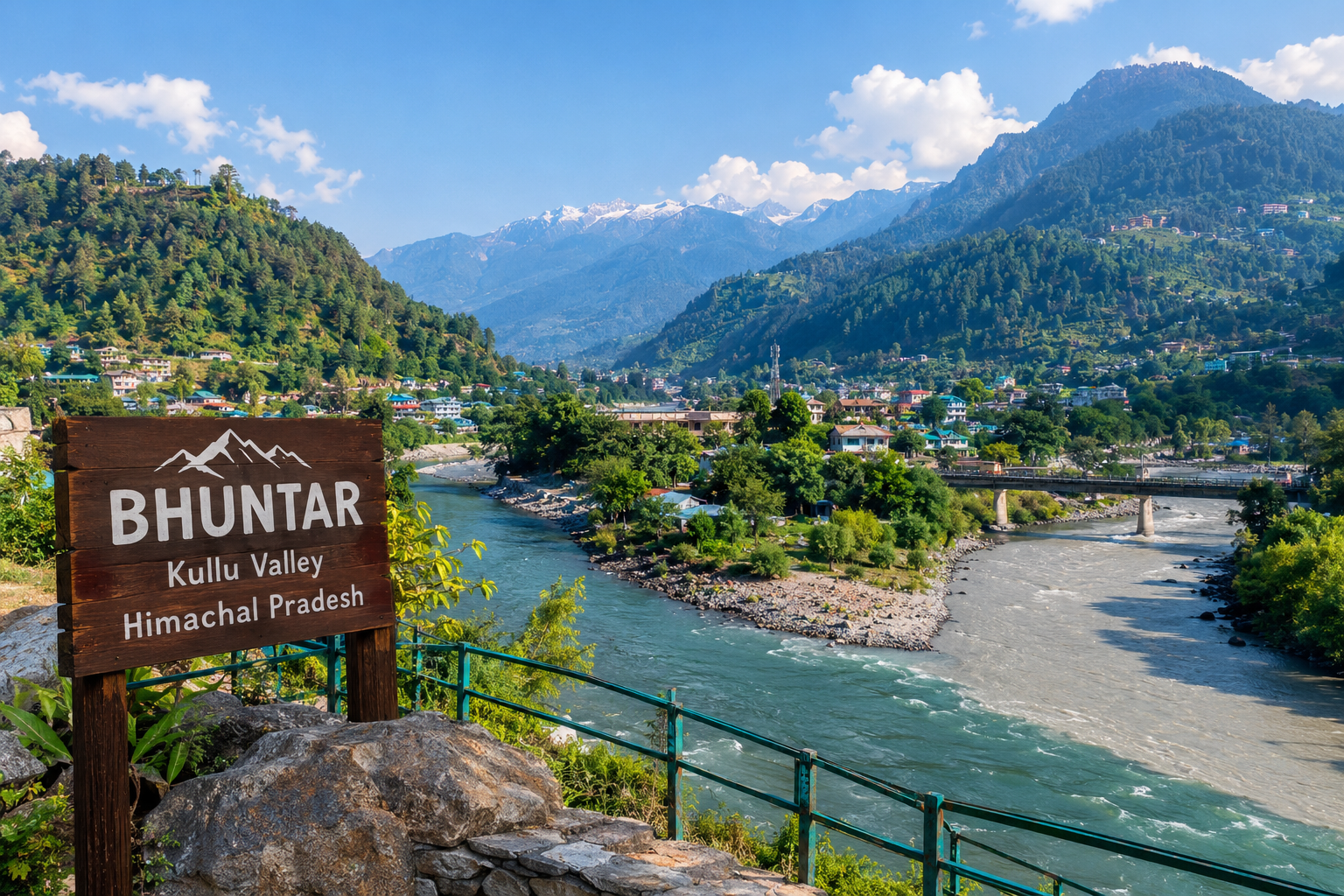
Bhuntar is often a stopover for travellers heading to Kullu, Manali, Kasol, and Manikaran. Located in Himachal Pradesh’s Kullu district, this small town sits at an important junction where routes lead towards different parts of the mountains. But Bhuntar is more than a stop for changing buses or arranging a taxi. Its riverside setting, religious landmarks, and convenient location make it worth considering when planning a trip through the Kullu region.
If you enjoy exploring places beyond the usual tourist circuit, Bhuntar can be a useful addition to your itinerary. You can visit a historic temple, enjoy the surrounding mountain scenery, or use the town as a base to travel further into the Parvati Valley.
Where is Bhuntar located?
Bhuntar is situated in Kullu district, around 10 Km from Kullu town. It lies near the meeting point of the Beas and Parvati Rivers and serves as an important road junction for travellers heading to Kasol, Manikaran, and the settlements further up the Parvati Valley.
The town is also home to Kullu-Manali Airport, commonly known as Bhuntar Airport, making it an important arrival point for visitors travelling by air. From here, the onward journey to Kullu, Manali or Parvati Valley continues by road.
Best places to visit in Bhuntar:
1. Basheshwar Mahadev Temple:
Basheshwar Mahadev Temple is one of the main cultural attractions to consider when visiting Bhuntar. Located in the nearby village of Bajaura, it is known for its traditional stone architecture and detailed carvings.
The temple complex contains sculptures associated with Hindu deities, making it an interesting stop for visitors interested in the religious and artistic heritage of the Kullu region. Its stonework also offers a glimpse into the area’s older temple-building traditions.
2. The Beas and Parvati River confluence:
The area around Bhuntar is known for the meeting of the Beas and Parvati rivers. This natural setting helps explain the town’s importance as a junction between the Kullu Valley and the Parvati Valley.
If you enjoy photography or simply want a quieter break during your journey, the surrounding river and mountain scenery can be a worthwhile part of your visit. However, do not approach the water carelessly. Himalayan rivers can have powerful currents, even when the surface appears calm.
3. Dechen Choekhor Mahavihara Monastery:
Located in the Sarabai area of Bhuntar, Dechen Choekhor Mahavihara is a Tibetan Buddhist monastery worth considering if you want a quieter cultural experience.
Its Buddhist architecture and peaceful surroundings offer a different atmosphere than any other region. You can include it in your itinerary if you are interested in Buddhist traditions, religious architecture, or simply exploring a less familiar part of the Kullu region.
4. Bijli Mahadev Temple:
If you have a little more time and enjoy walking in the mountains, consider Bijli Mahadev Temple near Kullu. This is not simply a quick roadside stop. Reaching the temple involves travelling towards the trailhead and completing an uphill walk
For many travellers, Bijli Mahadev Temple is better suited to a dedicated half-day outing than a tightly packed sightseeing schedule.
5. Khokhan wildlife sanctuary:
Khokhan wildlife sanctuary is an option for travellers interested in forested landscapes and nature walks around the Bhuntar region. Unlike a roadside attraction, exploring the area requires more planning.
Check local forest access rules and the condition of any intended walking route before setting out. Do not assume that all forest paths are open or suitable for casual visitors.
How to reach Bhuntar?
By bus or car:
Travelling by road is one of the most practical ways to reach Bhuntar. Buses connect the Kullu region with cities such as Delhi and Chandigarh, while taxis and private vehicles offer more flexibility.
If you are travelling from Delhi, you can look for a bus towards Kullu or Manali and check whether it stops at Bhuntar or not. From Chandigarh, you can travel towards Kullu by bus or car.
Road travel time depends on your starting point, traffic, weather, and road conditions. Check the latest bus schedule before departure, particularly if you have an onward connection to Kasol or Manikaran.
By air:
Kullu-Manali airport is located at Bhuntar, close to the town. This can be convenient if a suitable flight is available from your departure city. However, flight schedules are limited and may be affected by weather, so check availability before building your itinerary around a flight.
By train:
Bhuntar does not have a railway station. The nearest station would be Joginder Nagar that is approximately 60 Km away from Bhunter or the Pathankot railway station that is roughly around 150 km. So, if you are coming to Bhuntar via train, you still need to cover the rest of the journey by road.
Your Bhuntar Trip Plan: Choose your itinerary
Option 1: A One-day Bhuntar visit
Best for: Travellers passing through Kullu district or making a short stop before continuing elsewhere.
Morning: Arrive in Bhuntar and settle transport arrangements.
Late Morning: Visit Basheshwar Mahadev temple in Bajaura.
Afternoon: Explore the local area and enjoy the surrounding scenery from safe, accessible spots.
Evening: Continue towards Kullu or travel to your pre-booked accommodation.
This plan keeps the day manageable without trying to fit too many destinations into a short visit.
Option 2: A two-day Bhuntar and Kasol trip
Best for: Travellers who want to combine a cultural stop with time in Parvati Valley.
Day 1- Bhuntar and nearby heritage:
Arrive in Bhuntar, visit Basheshwar Mahadev temple, and explore the surrounding area. Stay overnight in Bhuntar if it suits your transport schedule, or continue to Kasol if you arrive early enough.
Day 2- Kasol and Manikaran
Spend the day exploring Kasol and visiting Manikaran Sahib. Leave sufficient time for the return journey or your onward destination. If you want a relaxed experience, consider staying overnight in Kasol rather than returning to Bhuntar.
Option 3: A three-day Kullu region trip
Best for: Travellers who want to explore more than one destination without rushing.
Day 1: Reach Bhuntar, visit Basheshwar Mahadev Temple, and continue to Kullu or stay nearby.
Day 2: Travel to Kasol, explore the village, and spend the night there.
Day 3: Visit Manikaran and return towards Bhuntar or continue with your wider Himachal itinerary.
This is a flexible route, not a fixed schedule. Adjust it according to your arrival time, accommodation, and transport availability.
Best time to plan your trip:
Spring and Autumn can be pleasant periods for exploring the lower valleys, while summer is popular for holidays in the Kullu region. Conditions vary from year to year, so check the forecast before travelling.
Monsoon travel requires particular care because heavy rain can cause landslides, road closures and river hazards. Winter brings colder temperatures, and conditions at higher elevations may differ considerably from those in Bhuntar.
Carry clothing suitable for changing mountain weather, and leave flexibility in your itinerary if you are travelling during the period of unsettled conditions.
What to check before leaving?
Use this simple checklist before starting your journey:
- Confirm your bus, flight, and road travel arrangements.
- Decide whether Bhuntar is your overnight stop or just a short visit
- Book accommodation in the destination where you intend to spend most of your time.
- Check road conditions and local transport for Kasol and Manikaran.
- Keep extra time for delays, especially during the monsoon.
- Carry suitable footwear, warm clothing and essential medicines.
- Avoid planning too many destinations into one day.
Conclusion:
Planning a trip in Bhuntar is less about filling your schedule with attractions and more about using your time wisely. The town can provide a convenient starting point for exploring Kullu, visiting Basheshwar Mahadev temple, and travelling into the Parvati Valley.
Decide whether you want a short stop or a longer regional trip before booking accommodation. With a realistic itinerary, confirmed transport, and some flexibility for mountain conditions, Bhuntar can fit smoothly into your Himachal Pradesh travel plans.
FAQs:
Q1. How many days are enough for Bhuntar?
A few hours or one night may be enough to explore Bhuntar itself. Two or three days make more sense if you plan to visit Kasol, Manikaran, or Kullu.
Q2. Can I visit Bhuntar and Kasol on the same trip?
Yes. Bhuntar is an important junction for travelling towards Kasol and the Parvati Valley. You can combine the two, but allow enough time for transport and sightseeing.
Q3. Is Bhuntar suitable for a family trip?
It can be included in a family itinerary, particularly as a connecting stop. Choose accommodation and onward transport according to your family’s needs and avoid rushing between destinations.
Q4. Should I stay in Bhuntar or Kasol?
If you mainly want to explore Kasol and Manikaran, staying in Kasol may be more convenient. Bhuntar is a practical option for a short stop or a journey that includes several parts of Kullu district.
Q4. Can I visit Bijli Mahadev from Bhuntar?
Yes, it can be included as an outing from the Bhuntar-Kullu area. However, reaching the temple involves road travel and an uphill walk, so allow enough time and check current conditions.